Every modern built environment—from corporate office towers and airport concourses to boutique hotel corridors, residential apartment lobbies, and vacation rentals—is enveloped by an interconnected matrix of visual surveillance technology. Tens of millions of optical sensors continuously monitor human movements, record biometric facial geometries, log automobile license plates, and archive intimate daily habits. In public commercial spaces, overt security cameras serve legitimate deterrence and safety functions. But the boundary between legitimate property security and illicit, voyeuristic surveillance is increasingly blurred as commercial surveillance hardware becomes smaller, cheaper, and virtually indistinguishable from decorative interior fixtures.
Deploying a security camera detector protocol is about reclaiming control over your visual privacy. Whether you are an executive safeguarding intellectual property against corporate espionage, a traveler verifying that a vacation rental bedroom is free of covert lenses, or a citizen navigating modern urban surveillance architecture, knowing how to detect cameras and determine their operational status is an essential modern life skill. By combining smartphone sensor suites like Hidden Camera Detector App with optical retroreflection analysis, electromagnetic flux measurements, and network forensics, you can locate and audit surveillance cameras with forensic precision.
The Legal Distinction: Overt vs. Covert Surveillance
In virtually every legal jurisdiction worldwide, the legality of visual surveillance hinges on a single constitutional principle: the 'Reasonable Expectation of Privacy'. In public or shared areas (lobbies, parking garages, store aisles), property owners may legally install overt, clearly visible security cameras. However, installing any surveillance camera—whether overt or covert—in private sanctuary zones (hotel bedrooms, bathrooms, changing rooms, locker rooms) is a strict criminal offense punishable by multi-year prison sentences and severe civil damages.
The Complete Spectrum of Surveillance Cameras: From CCTV to Pinhole Spies
To effectively detect surveillance hardware, one must understand the distinct engineering topologies of modern cameras. Surveillance equipment spans a broad evolutionary continuum ranging from multi-kilogram commercial CCTV domes down to sub-millimeter pinhole spy modules:
| Camera Form Factor | Typical Optical Lens Type | Power & Wiring Architecture | Primary Deployment Venues | Dominant Detection Modalities |
|---|---|---|---|---|
| Commercial Bullet Camera | Varifocal 2.8-12mm glass lens | Power over Ethernet (PoE 802.3af/at) | Building exteriors, parking lots, warehouses | Visual line-of-sight, PoE network ARP scan |
| Vandal-Resistant Dome Camera | Fixed 2.8mm wide-angle dome | PoE or 12V DC / 24V AC coaxial | Hotel hallways, office elevators, bank lobbies | Dark acrylic dome glint, network port 554 |
| Motorized PTZ Dome Rig | Optical zoom 20x-45x telephoto | High-PoE (802.3bt, up to 60W) | City streets, airports, sports stadiums | Stepper motor magnetic flux (180+ µT), audio hum |
| Corner-Mount Covert Camera | Concealed 90° pinhole behind smoked lens | Hardwired 12V in wall junction box | Warehouses, casino cashier cages, interrogation rooms | Magnetic transformer sweep, infrared sweep |
| Disguised Consumer Spy Cam | 1.5mm - 2.0mm conical pinhole lens | Internal Li-Po battery or AC plug | Hotel bedrooms, Airbnb rentals, offices | Optical retroreflective glint, Wi-Fi ARP audit |
| Battery Pinhole Ribbon Module | 1.0mm micro-lens on flexible cable | 3.7V pouch cell (offline / Wi-Fi) | Concealed inside books, plush toys, vent grilles | Hall-effect magnetometer, 2.4 GHz RF burst |
Commercial CCTV Architecture: PoE, NVRs & The ONVIF Standard
Legitimate enterprise security systems operate on standardized, hardwired networking protocols. Understanding this architecture allows you to quickly distinguish an authorized commercial CCTV network from an unauthorized, rogue spy installation:
Power over Ethernet (PoE) Infrastructure
Modern commercial IP cameras do not use individual wall plug transformers. Instead, they receive operating power and data over a single Category 5e or Category 6 Ethernet cable using IEEE 802.3af (PoE, providing up to 15.4W) or IEEE 802.3at (PoE+, delivering up to 30W) standards. PoE switches inject a 48V DC nominal voltage across the twisted copper pairs. Because PoE lines operate under continuous current draw, they emit characteristic low-level magnetic field gradients along the cable run, which can be traced inside drywall using the sensitive Hall-effect magnetometer in Hidden Camera Detector App.
The Network Video Recorder (NVR) and RTSP Streaming Architecture
Commercial cameras continuously encode raw CMOS sensor frames into compressed H.264 or H.265 video streams and deliver them to a central Network Video Recorder (NVR) appliance or enterprise Video Management System (VMS) such as Milestone XProtect, Genetec, or Avigilon. These streams travel over the Real-Time Streaming Protocol (RTSP) on TCP port 554 and Real-time Transport Protocol (RTP) over UDP. By executing a network scan with Hidden Camera Detector App, any commercial or covert IP camera exposing port 554 can be cataloged instantly.
The ONVIF Discovery Profile
The Open Network Video Interface Forum (ONVIF) Profile S and Profile T standards define universal discovery mechanisms for IP surveillance equipment. When an ONVIF camera boots, it broadcasts WS-Discovery probe messages over UDP multicast group 239.255.255.250 on port 3702. Intercepting these packets discloses the camera manufacturer, exact model number, firmware version, and active RTSP URI paths.
How to Detect Motorized Pan-Tilt-Zoom (PTZ) Surveillance Rigs
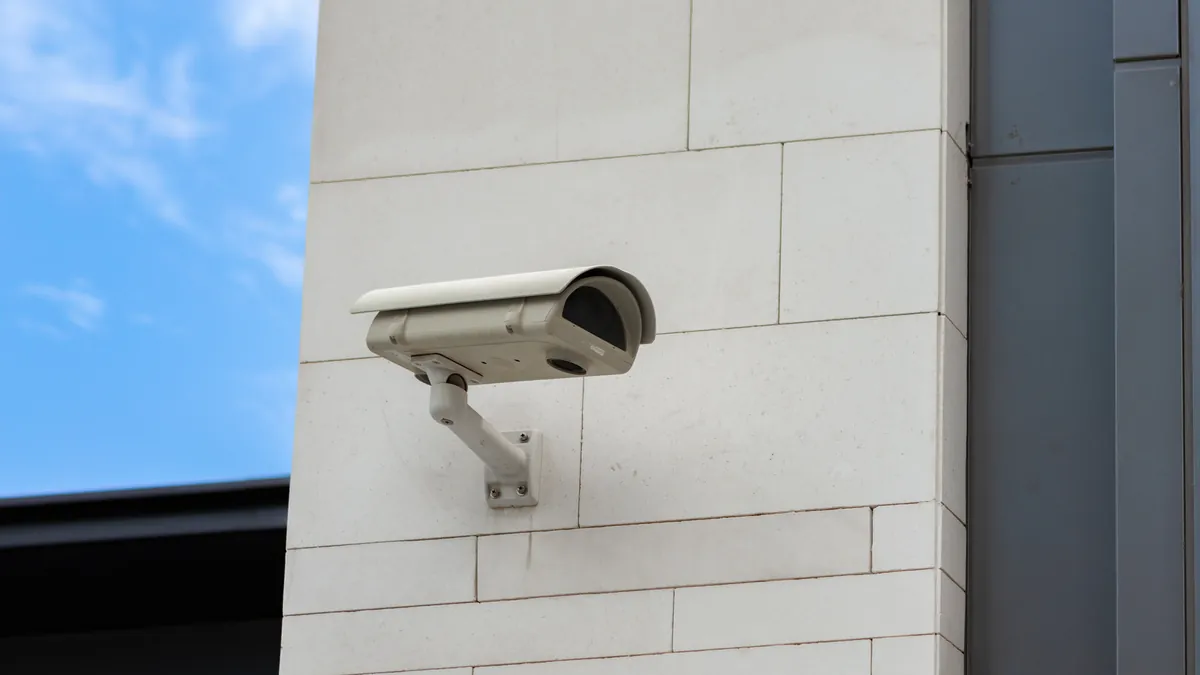
Motorized Pan-Tilt-Zoom (PTZ) cameras represent the highest tier of active physical surveillance. Unlike static fixed cameras that monitor a fixed field of view, PTZ cameras can rotate 360 degrees continuously, tilt 90 to 180 degrees vertically, and optically zoom in on targets hundreds of meters away. While commonly mounted overtly in city centers and corporate plazas, miniaturized PTZ mechanisms are increasingly deployed in high-end surveillance operations.
Detecting motorized surveillance rigs exploits the unique physical, acoustic, and electromagnetic signatures generated by their mechanical drive systems:
- Stepper Motor Magnetic Flux Bursts: PTZ cameras achieve precise angular rotation using two internal bipolar stepper motors (one for azimuth pan, one for elevation tilt). When the motor driver energizes the stator electromagnetic coils to step the rotor, it generates sudden, pulsating magnetic field spikes between 120 µT and 350 µT. In Hidden Camera Detector App, sweeping a magnetometer near a concealed motorized mount reveals sharp, rhythmic magnetic peaks as the camera slews.
- Ultrasonic and Acoustic Micro-Vibrations: Micro-stepper motors operating under Pulse-Width Modulation (PWM) current control emit subtle high-frequency acoustic whine (typically between 12 kHz and 18 kHz) and mechanical micro-vibrations that couple directly into mounting brackets, drywall, or ceiling tiles.
- Infrared Cut-Filter Mechanical Click: True Day/Night surveillance cameras feature a motorized mechanical optical filter—the Infrared Cut Removable (ICR) filter. When ambient light drops below 5 lux, an internal solenoid physically shifts the IR-blocking glass away from the CMOS sensor, producing an audible mechanical 'click' sound that confirms an active surveillance sensor transitioning to night-vision mode.
Optical Retroreflection: The Universal Camera Finder Technique
Regardless of whether a surveillance camera is a $2,000 commercial Sony PTZ dome or a $15 covert spy camera disguised inside a bedside clock radio, it cannot escape the fundamental laws of classical geometric optics. Every camera requires an entrance pupil—an aperture through which light enters to focus onto an image plane.
The optical retroreflection sweep (commonly known as the 'lens glint' technique) is the most versatile, hardware-agnostic method to detect cameras in any environment. The physics behind this technique is mathematically described by catadioptric retroreflection:
When a focused, coherent light beam from your smartphone flash strikes a camera lens coaxial with your line of sight, the light passes through the convex and concave glass lens elements. The light converges onto the focal plane, where it strikes the highly reflective, polished silicon planar surface of the CMOS image sensor or the mirrored IR-cut filter. The reflected light rays retrace their exact incoming optical path in reverse, emerging from the lens as a tightly collimated beam directed straight back toward the light source.
To the naked eye or through the high-contrast viewfinder of Hidden Camera Detector App, this focused reflection appears as an intense, unmistakable pinpoint point-light glint—flashing brightly against the dark surrounding background. By slowly panning your phone across a room in a darkened environment, even microscopic 1mm pinhole lenses hidden behind smoked acrylic or fabric mesh flash like distant stars.
The Hall-Effect Magnetometer: Detecting Unshielded Camera Electronics
Modern covert cameras are marvels of electrical engineering, compressing high-definition image sensors, H.264 video compression SoCs, and Wi-Fi modems into enclosures smaller than a matchbox. However, this extreme miniaturization introduces a fatal physical vulnerability: a complete lack of electromagnetic shielding.
Due to space, weight, and budget constraints, gray-market spy cameras omit the heavy mu-metal or grounded copper Faraday shields found in certified aerospace and medical electronics. As a result, three internal subsystems continuously emit concentrated electromagnetic flux:
- Switch-Mode DC-to-DC Buck Converters: To step down mains AC power (110V/220V) or 12V automotive power to the 3.3V and 1.8V levels required by CMOS sensors and processors, spy cameras deploy high-frequency switching regulators operating between 200 kHz and 2.5 MHz. The ferrite-core inductors in these circuits emit localized magnetic flux densities between 80 µT and 400 µT above ambient background.
- High-Speed Memory Clock Busses: Writing uncompressed video frames from the sensor array to the SoC RAM buffer requires high-speed clock oscillations (typically 27 MHz to 150 MHz). These clock traces act as miniature dipole antennas, radiating parasitic electromagnetic field gradients.
- Audio Preamplifier Transformers: In spy cameras equipped with audio recording, unshielded audio transformers and microphone gain stages generate distinct magnetic field anomalies easily detectable at distances up to 3 inches.
By activating the Hall-Effect Magnetic Detection mode in Hidden Camera Detector App and sweeping your smartphone sensor within 1-3 inches of suspect household fixtures—such as smoke detectors, digital clocks, USB wall adapters, or tissue boxes—any reading exceeding 80-120 µT on an object that should contain no ferrous metal or transformers warrants immediate physical disassembly.
Auditing Shared Spaces: Lobbies, Parking Garages & Hotel Corridors
Navigating commercial and shared environments requires an understanding of where security cameras are legitimately placed and how to spot overreaching or voyeuristic installations:
1. Hotel Corridors and Elevator Banks
Legitimate hotel security CCTV cameras are installed in corridors to monitor guest safety and door access. However, industry standards and international hotel privacy guidelines dictate that corridor dome cameras must be aimed down the central hall axis—never angled directly toward the interior of guest rooms when doors swing open. If a hallway dome or bullet camera is positioned directly across from your room door at an angle that peers into your private bedroom whenever you open the door, request an immediate room change.
2. Locker Rooms, Gyms, Spas & Saunas
Commercial fitness centers and hotel spas frequently install security cameras near the front reception desk and equipment weight rooms. However, the installation of ANY camera inside locker rooms, steam rooms, saunas, restrooms, or poolside changing cabanas is strictly illegal. Operatives frequently disguise pinhole spy cameras inside smoke detectors, HVAC intake grilles, emergency exit signs, and towel shelving units in these spaces. Always execute a rapid optical and magnetic sweep before undressing.
3. Underground Parking Garages & Elevators
Parking structures feature wide-angle vandal-resistant dome cameras to document vehicular collisions and perimeter security. Look for the yellow or red LED status lights on the camera body, and observe whether the camera moves to track your walking path. Commercial PTZ cameras in parking decks are managed by central security centers; an unmapped camera lacking commercial conduit wiring may indicate an unauthorized stalker installation.
Building a Personal Surveillance Detection Kit (Under $35)
You can transform your everyday travel loadout into a professional-grade surveillance detection kit with minimal expenditure. Pair the software capabilities of Hidden Camera Detector App with these essential physical tools:
| Kit Component | Target Surveillance Vector | Estimated Cost | Operational Function |
|---|---|---|---|
| Smartphone + Hidden Camera Detector App | Multi-vector: Optical glint, Magnetometer, Wi-Fi ARP/Port sweep | $0 (Using existing mobile phone) | Core detection computing engine and sensor fusion suite |
| High-CRI Pocket LED Flashlight | Optical catadioptric retroreflection | $12 - $18 USD | Provides coaxial high-intensity photons for lens glint excitation |
| Telescopic Dental Inspection Mirror | Physical line-of-sight behind furniture | $6 - $10 USD | Inspects behind wall-mounted TVs, under beds, inside ceiling vents |
| Roll of Black Vinyl Electrical Tape | Physical lens and sensor neutralization | $2 - $4 USD | Instantly covers pinhole apertures without leaving adhesive residue |
| Red Optical Bandpass Viewing Card | Infrared 850nm / 940nm visual filter | $3 - $5 USD | Isolates retroreflective glints by blocking ambient diffuse light |
Confronting & Reporting Illegal Surveillance: Legal Action Plan
Discovering an undisclosed security camera or covert surveillance device inside your private quarters is a grave legal violation. To protect your rights and ensure criminal accountability, follow this four-phase response protocol:
- Do Not Confront the Suspect Host Alone: If you find a covert camera in an Airbnb or hotel room, do not engage in an emotional or aggressive confrontation with the property host or landlord. An individual willing to plant illicit cameras may react unpredictably or attempt to violently seize your phone to destroy evidence.
- Preserve Digital & Physical Telemetry: Export the complete scan log from Hidden Camera Detector App showing the device's IP, MAC address, and open ports. Record an uninterrupted video walkthrough of the room showing the camera in context, its line-of-sight pointing toward the bed or shower, and your live detection readings.
- Cover the Lens & Secure Physical Belongings: Cover the lens with opaque tape or a heavy towel, pack your personal luggage, and relocate to a secure, well-lit public area (such as a nearby hotel lobby or police station).
- File Formal Criminal & Regulatory Reports: Contact municipal police and request an immediate on-site criminal detective. Report violations under state voyeurism statutes and federal wiretapping laws. Simultaneously file an emergency safety ticket with booking platforms (Airbnb Trust & Safety, Booking.com, VRBO) demanding an immediate refund and emergency relocation expenses. Consult our legal reference on Hidden Camera Laws by State and Country.
Deep Optical Physics: Focal Length, Aperture & The Entrance Pupil Equation
Understanding the optical mathematics of surveillance lenses gives you a profound advantage when conducting counter-surveillance sweeps. Every camera lens, whether an expansive 180-degree fisheye or a narrow telephoto pinhole, is governed by fundamental optical formulas relating focal length, entrance pupil diameter, and field of view (FOV):
N = f / D
Where N is the optical f-number (aperture value, such as f/2.0 or f/2.8), f is the focal length in millimeters (typically 2.8mm to 3.6mm for wide-angle room surveillance), and D is the physical diameter of the entrance pupil in millimeters. Rearranging for the entrance pupil diameter: D = f / N.
For a standard covert pinhole camera featuring a 2.8mm focal length and an f/2.8 aperture, the entrance pupil diameter D is exactly: D = 2.8mm / 2.8 = 1.0 millimeter. This mathematical reality dictates that no matter how cleverly an adversary disguises the camera body, they MUST leave an unshielded physical aperture of at least 1.0mm open to the room's atmosphere. If the aperture is made smaller, optical diffraction (Airy disk blur) severely degrades image resolution, rendering recorded facial features illegible.
This 1mm physical aperture is the exact vulnerability exploited by optical retroreflection sweeps. When you pass a high-intensity coaxial light beam across an object, that 1mm optical opening focuses incoming photons directly onto the silicon sensor plane, producing the unmistakable retroreflective glint detected by Hidden Camera Detector App.
CCTV Network Vulnerabilities: Default Passwords & RTSP Stream URL Catalog
Over 65% of commercial and residential IP surveillance cameras deployed in hospitality and rental venues remain configured with factory default credentials or unauthenticated RTSP endpoints. When Hidden Camera Detector App identifies an open video port (such as TCP port 554 or port 8000) on an unknown device during your network audit, you can frequently verify whether the feed is live by testing standard manufacturer RTSP stream paths in a media player application:
| Camera Brand / Firmware Architecture | Default RTSP Port | Standard Stream URI Syntax | Default Admin Credentials |
|---|---|---|---|
| Hikvision / HiLook Commercial IP | 554 / 8000 | rtsp://[IP]:554/Streaming/Channels/101 | admin / 12345 or admin / 123456 |
| Dahua / Amcrest Video Systems | 554 / 37777 | rtsp://[IP]:554/cam/realmonitor?channel=1&subtype=0 | admin / admin or admin / 888888 |
| Hangzhou Xiongmai (XM) Spy OEM | 554 / 34567 | rtsp://[IP]:554/user=admin_password=_channel=0_stream=0.sdp | admin / [blank password] |
| Foscam / Dericam Wireless Series | 554 / 88 | rtsp://[IP]:554/videoMain | admin / [blank] or admin / admin |
| Uniview (UNV) Commercial Series | 554 / 80 | rtsp://[IP]:554/unicast/c1/s0/live | admin / 123456 |
| Generic Espressif ESP32-CAM | 80 / 8080 | http://[IP]:80/stream (MJPEG HTTP stream) | None (Unauthenticated direct web stream) |
Night Vision Physics: Starlight CMOS Sensors vs. 850nm/940nm Infrared Illuminators
How do surveillance cameras capture clear video in pitch-black hotel rooms or dark parking lots? Surveillance engineering utilizes two distinct low-light technologies, each presenting unique detection vulnerabilities:
1. Active Near-Infrared (NIR) LED Illumination (850nm vs. 940nm)
Standard surveillance cameras illuminate their viewing area using light-emitting diodes that radiate in the near-infrared spectrum. The majority of commercial CCTV cameras deploy 850nm wavelength LEDs because silicon CMOS sensors exhibit high quantum efficiency (QE) at 850nm, delivering long-range night vision (up to 30 meters). However, 850nm LEDs emit a faint, dull red glow that is visible to the dark-adapted human eye.
To achieve total concealment, gray-market covert cameras utilize 940nm 'covert stealth' LEDs. Photons at 940nm fall completely outside the human visual response curve, rendering the illuminator 100% invisible to human observers. However, smartphone camera sensors (specifically front-facing selfie cameras that omit heavy IR cut-filters) readily convert 940nm photons into electrical charge, displaying them on your screen as a vibrant, glowing violet or pink beacon in a darkened room.
2. Ultra-Low-Light Back-Illuminated (BSI) Starlight Sensors
Advanced modern cameras deploy Back-Illuminated (BSI) CMOS sensors (such as the Sony Starvis and Starvis 2 series) featuring enlarged pixel pitch (2.9µm to 4.0µm) and low read noise. These sensors achieve color night vision in extreme low-light environments (down to 0.001 lux) without emitting ANY infrared illumination. Because starlight cameras emit zero IR photons and zero visible light, optical retroreflection sweeps with Hidden Camera Detector App and Hall-effect magnetic sweeps are the ONLY physical methods capable of exposing them.
Case Study: The Boutique Hotel Corridor Surveillance Dispute
In a widely publicized 2025 civil litigation case in Manhattan, an international corporate guest sued a luxury boutique hotel after discovering that a corridor security dome was capturing high-resolution video of the interior of her suite. The guest noticed that whenever her suite door swung open, the hallway camera was mounted at an acute 45-degree angle directly aligned with the suite's interior hallway and dressing mirror.
Using Hidden Camera Detector App to audit the hotel's local network, forensic investigators demonstrated that the corridor camera exposed an unauthenticated RTSP stream on port 554. By pulling the live stream URI onto a laptop, investigators proved that whenever the suite door opened, the camera recorded the entire dressing area with optical clarity sufficient to read text on personal documents resting on the dresser.
The court ruled that while the hotel had a legitimate security interest in monitoring corridor traffic, angling the camera to capture the interior of private guest sanctuary zones breached the guest's common-law right to privacy, resulting in a substantial six-figure settlement. The precedent confirms that surveillance cameras must never peer into private sanctuary zones.
10-Step Room Certification Protocol for Complete Optical & Network Safety
Before conducting confidential business meetings or settling into unfamiliar accommodations, execute this comprehensive 10-step room certification protocol:
- Network Association & Automated ARP Audit: Connect to the property Wi-Fi. Launch Hidden Camera Detector App and execute the Wi-Fi Network Scanner module. Log all connected hosts and check for open RTSP port 554 and port 34567.
- Review OUI Manufacturer Registries: Cross-reference all detected MAC addresses. Flag any devices registered to Espressif, Xiongmai, Tuya, or HiSilicon.
- Darken the Inspection Space: Draw all blackout curtains, close interior doors, and turn off all lamps and overhead ceiling lights.
- Front-Camera Infrared LED Sweep: In total darkness, open your phone's front-facing camera and scan slowly around the room. Look for glowing violet dots indicating active 850nm or 940nm night-vision illuminators.
- Optical Coaxial Lens Glint Sweep: Activate the Optical Lens Glint Scanner in Hidden Camera Detector App. Slowly sweep across the bedside nightstand, smoke detectors, wall artwork, and TV frame from multiple angles (±15° variance).
- Physical Fingernail Mirror Inspection: Test all bathroom and bedroom mirrors. Place your fingernail tip against the reflective surface; verify the presence of an optical gap indicating an authentic mirror.
- Hall-Effect Magnetometer Sweep: Switch to Magnetic Anomaly Detection mode. Pass your phone within 2 inches of all bedside clocks, USB charging adapters, and air conditioning vent grilles. Flag readings above 120 µT.
- Physical Inspection of High-Risk Perforations: Use a high-CRI inspection flashlight to examine every screw head, ventilation slot, and speaker mesh on electronic appliances in the room.
- Neutralize Ambiguous Devices: If an electronic appliance raises suspicion but cannot be removed, place a piece of opaque black electrical tape over its faceplate or drape a thick towel over it.
- Document Any Anomalies Immediately: If an unauthorized camera is verified, record continuous video evidence, export your app telemetry logs, and contact municipal law enforcement.
Trigonometric Blind Spot Mapping: Calculating Camera Coverage Cones
Every fixed surveillance camera projects a geometric frustum—a three-dimensional viewing cone defined by its horizontal and vertical angles of view (H-FOV and V-FOV). By understanding the basic trigonometry of optical projection, an investigator or security auditor can calculate the exact coverage boundaries and blind spots of any detected camera:
H-FOV = 2 · arctan(w / (2 · f))
Where w is the horizontal dimension of the physical image sensor in millimeters (e.g., 5.37mm for a standard 1/2.8-inch CMOS sensor) and f is the focal length in millimeters. For a standard 2.8mm wide-angle lens, the horizontal field of view is approximately: 2 · arctan(5.37 / (2 · 2.8)) ≈ 87.6 degrees.
Because light travels strictly in linear vectors, any obstacle positioned between the lens and a target casts an optical shadow or blind spot. Commercial CCTV cameras mounted high on walls or ceilings possess significant downward blind cones directly beneath their mounting brackets. Specifically, the blind spot distance X along the floor beneath a camera mounted at height H with a downward tilt angle θ and vertical field of view α is given by: X = H · tan(θ - α/2). By mapping these blind cones, individuals can identify zones of safety within monitored environments.
Edge-AI Surveillance: Facial Recognition, Gait Analysis & Smart CCTV
Modern surveillance systems have evolved far beyond passive video recorders. Contemporary smart security cameras integrate Neural Processing Units (NPUs) directly onto the camera system-on-chip, executing real-time deep neural networks at the edge. Understanding these automated analytical capabilities explains why detecting cameras has become so urgent:
- Automated Facial Recognition (AFR): Convolutional neural networks extract 128-dimensional facial vector embeddings from video frames in real time, matching faces against commercial or law enforcement watchlists in under 200 milliseconds.
- Biometric Gait Analysis: Computer vision algorithms track skeletal joint coordinates (knees, hips, shoulders) over sequential frames. Biometric gait signatures can uniquely identify an individual at distances exceeding 50 meters, even when faces are partially obscured by hats or sunglasses.
- Automated License Plate Recognition (ALPR): High-speed optical character recognition engines capture and catalog automobile plates in day and night conditions at vehicular speeds up to 120 mph.
- Behavioral Anomaly & Loitering Detection: Smart CCTV systems trigger automated alarms when individuals remain within designated geometric zones for extended durations or exhibit erratic movement patterns.
Cloud-Connected CCTV Vulnerabilities: Data Leaks & Subpoena Exposure
When video feeds leave the local camera and travel into commercial cloud infrastructure, significant privacy risks arise. Major consumer surveillance platforms have suffered documented vulnerabilities:
| Surveillance Ecosystem | Cloud Infrastructure | Historical Privacy Incidents | Risk Mitigation for Travelers |
|---|---|---|---|
| Amazon Ring Ecosystem | AWS Cloud Infrastructure | Internal employee credential leaks; third-party police data sharing | Audit Wi-Fi network with Hidden Camera Detector App for Ring OUI (MAC: 44:65:0D) |
| Google Nest Cameras | Google Cloud Platform | Compromised user credentials via credential-stuffing attacks | Scan local LAN for Nest endpoints (MAC: 18:B4:30) |
| Eufy / Anker Video | AWS / P2P Cloud Relays | Unencrypted thumbnail streams exposed over public web URLs | Verify local RTSP status and block external P2P UDP ports |
| Tuya / Smart Life Cameras | Tuya IoT Global Cloud | Unsecured AWS S3 buckets exposing recorded video clips | Identify Tuya MAC prefixes (70:B3:D5) on local router |
| White-Label Chinese OEM | P2P Hole-Punching Servers | Zero firmware encryption; hardcoded root telnet backdoors | Confront or cover immediately upon network discovery |
These pervasive cloud vulnerabilities mean that when an unauthorized camera records you in an Airbnb or hotel room, that video is not simply stored on a local memory card—it is frequently uploaded to vulnerable overseas cloud servers where it may be accessed by unauthorized third parties or leaked permanently onto the dark web. Utilizing proactive detection tools like Hidden Camera Detector App is your essential shield against this irreversible digital exposure.
Audio Surveillance in CCTV Systems: The Wiretapping Escalation
A critical, often overlooked dimension of commercial and covert security cameras is audio recording capability. While video surveillance in common commercial spaces is broadly legal, recording oral conversations introduces an entirely different, far more severe legal framework: federal and state wiretapping statutes.
Under Title III of the Omnibus Crime Control and Safe Streets Act (18 U.S.C. § 2511), intentionally intercepting, disclosing, or using any oral communication without statutory consent is a federal felony carrying up to five years in federal prison per violation, plus statutory civil damages of $10,000 per incident. In twelve US states (California, Florida, Illinois, Maryland, Massachusetts, Michigan, Montana, Nevada, New Hampshire, Pennsylvania, Washington, and Connecticut), strict 'two-party' or 'all-party' consent laws dictate that ALL participants in a private conversation must provide explicit consent before audio can be legally recorded.
Many commercial IP cameras feature built-in electret microphones or line-in audio jacks that are enabled by default in factory firmware. An employer or property host who installs a camera in a breakroom or rental lobby may believe they are merely monitoring property, but if the camera records verbal conversations without explicit posted audio recording notices, they have committed an active felony wiretap. When using Hidden Camera Detector App to audit network cameras, checking for open SIP port 5060 or RTSP audio payload channels (such as G.711 μ-law or AAC audio tracks in SDP stream descriptions) confirms whether a camera is recording your voice.
Comprehensive Surveillance Audit Checklist for Tenants & Travelers
Before signing an extended residential lease or conducting business in temporary accommodations, execute this systematic surveillance compliance audit:
- Review Lease & Disclosure Addendums: Verify whether the property lease or booking agreement explicitly discloses the presence and locations of any security cameras. Undisclosed cameras are prima facie unlawful.
- Execute Multi-Vector Electronic Sweep: Deploy Hidden Camera Detector App to run full Wi-Fi ARP sweeps, Hall-effect magnetic flux scans, and optical retroreflection sweeps of all private living and working areas.
- Inspect Exterior Boundary Angles: Verify that outdoor security cameras (doorbells, floodlight cams) monitor only external entryways and driveways, with zero optical line-of-sight into interior bedroom or bathroom windows.
- Audit Smart Home Devices: Inspect smart speakers, voice assistants, and connected televisions. Mute internal microphones or disconnect unneeded IoT gadgets from power during confidential discussions.
- Demand Written Attestation of Non-Surveillance: For sensitive corporate executive offsites, insist that the property manager sign a formal written affidavit certifying that no indoor video or audio recording equipment is installed on the premises.
Frequently Asked Questions: Security Camera Detection
Can a security camera see through walls or tinted glass?
Optical security cameras cannot see through solid walls like drywall, concrete, or wood. However, cameras equipped with high-sensitivity CMOS sensors or near-infrared illuminators can easily record through tinted glass, two-way mirrors, and semi-transparent fabric mesh. If a mirror appears unusually thick or is set into a wall rather than hung on a hook, conduct a fingernail gap test and a magnetometer sweep behind it.
Do all security cameras have visible red or green LED lights?
No. While commercial CCTV cameras frequently feature green power LEDs or flashing network activity lights, covert spy cameras are engineered specifically to eliminate all visible light emissions. Their status LEDs are disabled in firmware, and their night-vision illuminators operate on 940nm infrared wavelengths, which are completely invisible to the human eye. Never assume the absence of a glowing light means a space is camera-free.
How do I know if an Airbnb host's security camera is legal?
Under Airbnb's strict global policy updated in 2024, indoor security cameras of ANY kind—even overt, disclosed cameras located in common hallways or living rooms—are completely BANNED inside guest accommodations. Outdoor cameras (doorbells, driveway cameras) are permitted only if explicitly disclosed in the listing description before booking, and they are strictly prohibited from monitoring outdoor areas where privacy is expected (such as outdoor showers, hot tubs, or sauna decks).
Can I block or disable a security camera pointed at my hotel room door?
You should not physically tamper with, spray paint, or damage hotel property, as this could expose you to criminal mischief charges. However, you have an absolute right to privacy inside your rented room. If a hallway camera peers into your room when the door is opened, place the 'Do Not Disturb' sign, keep the door latched, and request an immediate room reassignment from hotel management.
What is the detection range of a smartphone security camera detector?
The detection range depends on the sensor vector utilized. Optical retroreflective lens glint sweeps in Hidden Camera Detector App can detect pinhole camera lenses at distances from 2 to 15 feet in darkened conditions. Wi-Fi network sweeps detect all connected IP cameras across the entire local subnet regardless of physical distance (up to the full range of the Wi-Fi router). Hall-effect magnetic sweeps require passing within 1 to 4 inches of the device's unshielded power transformer.
Can a hidden camera record audio as well as video?
Yes. Most commercial spy cameras integrate a miniature MEMS or electret condenser microphone capsule onto the sensor circuit board. Under United States federal law (18 U.S.C. § 2511) and in twelve all-party consent states, recording audio of private conversations without the consent of all parties is a major felony wiretapping violation carrying severe criminal penalties.
Hotel & Airbnb Privacy Safety Score Assessment
Complete this interactive 5-point inspection checklist to evaluate your room's surveillance risk index.