
Most diets fail because they force you to micromanage every gram of food on your plate. Intermittent fasting takes the opposite approach by focusing on a single variable: timing. By establishing clear boundaries between when you eat and when you fast, you allow your digestive system to rest and trigger a cascade of cellular repair processes that never occur in a constantly fed state.
Executive Summary & Research Finding
Explore every major intermittent fasting plan with clinical research evidence. Compare 16:8, 14:10, 18:6, 20:4 Warrior, and Circadian fasting schedules for fat loss and metabolic health.
The core physiological mechanism behind all fasting protocols is the metabolic switch. When you eat, your body uses glucose from carbohydrates for energy and stores the excess as glycogen in the liver or as body fat. After approximately 10 to 14 hours without food, liver glycogen stores become depleted. Your liver begins converting stored fatty acids into ketone bodies, shifting your primary fuel source from sugar to fat.
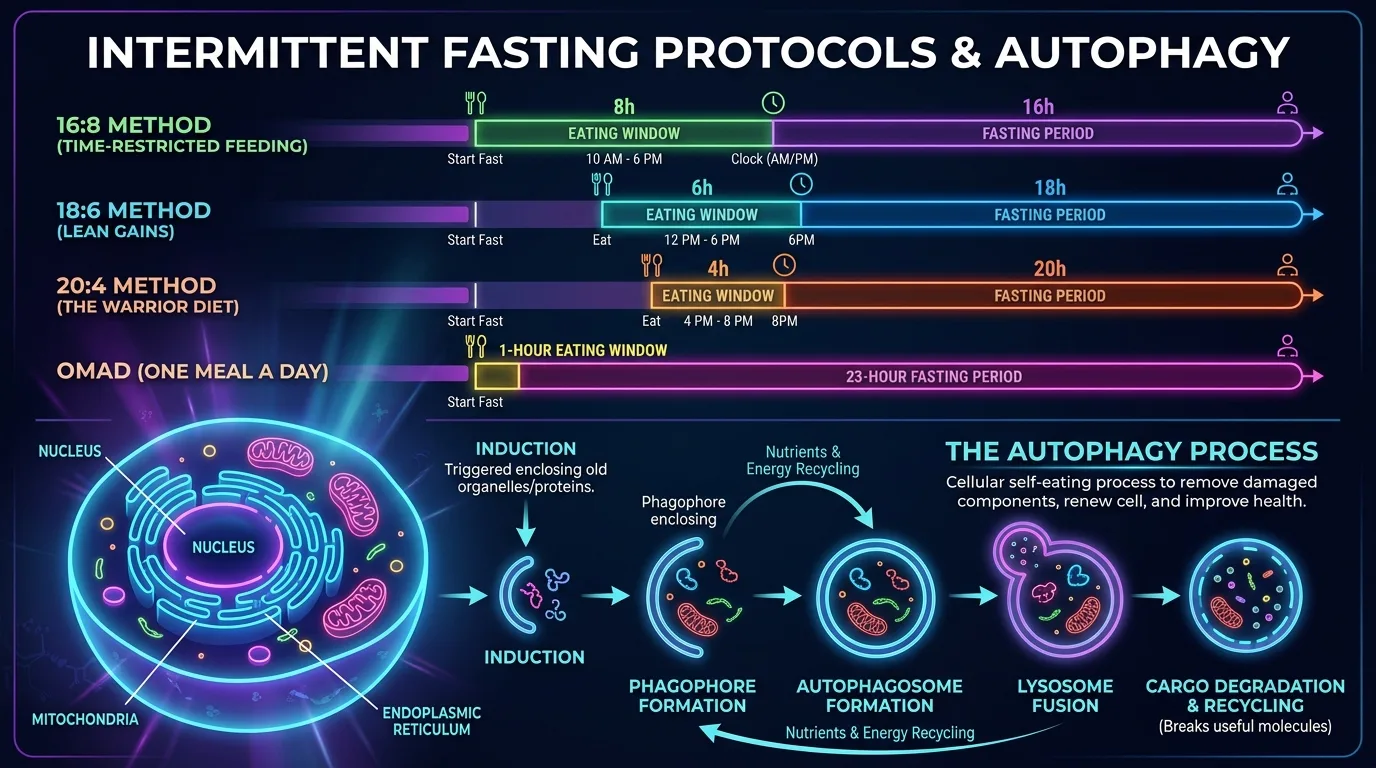
The Primary Daily Fasting Protocols Explained
Fasting is not a one-size-fits-all practice. Different schedules produce different depths of metabolic adaptation. Here is how the most popular daily time-restricted eating protocols function in real life.
1. The 14:10 Protocol (The Beginner Foundation)
The 14:10 plan involves fasting for 14 hours and consuming all daily meals within a 10-hour window (for example, from 9:00 AM to 7:00 PM). Because 7 to 8 of those fasting hours occur while you sleep, this protocol requires minimal lifestyle friction.
- Best for: Beginners, people with demanding morning physical jobs, and individuals who want to eliminate late-night snacking.
- Biological impact: Stabilizes morning fasting blood glucose and resets insulin sensitivity without triggering elevated cortisol levels.
- Ease of adoption: Very high. Most people adapt within 48 to 72 hours.
2. The 16:8 Method (The Gold Standard)
The 16:8 schedule is the most widely practiced and thoroughly researched fasting protocol in clinical literature. You fast for 16 hours and eat within an 8-hour window (typically 12:00 PM to 8:00 PM).
Crossing the 14-hour threshold is where substantial fat oxidation begins. Insulin drops to baseline, human growth hormone (HGH) increases to preserve lean muscle tissue, and early-stage cellular cleanup (autophagy) initiates.
- Best for: Long-term body composition management, busy professionals, and sustained daily energy without afternoon brain fog.
- Typical schedule: Skip breakfast, drink black coffee or water through the morning, break fast at noon with a high-protein lunch, and finish dinner by 8:00 PM.
- Sustainability: Excellent. Thousands of practitioners maintain 16:8 for years without metabolic slowdown.
3. The 18:6 Protocol (Advanced Fat Burning)
For individuals who plateau on 16:8 or want deeper ketosis, the 18:6 protocol compresses the eating window to 6 hours (for example, 1:00 PM to 7:00 PM) and extends fasting to 18 hours.
An extra two hours in a fasted state significantly increases hepatic lipid clearance and activates AMP-activated protein kinase (AMPK), an enzyme that stimulates mitochondrial biogenesis and longevity pathways.
4. The 20:4 Warrior Protocol (Intensive Single-Window)
Popularized as the Warrior Diet, this regimen features a 20-hour fast followed by a 4-hour evening eating window. Practitioners consume one substantial nutrient-dense dinner and optionally a small healthy snack.
- Best for: Experienced fasters seeking rapid body recomposition and maximum daytime alertness.
- Nutritional requirement: You must consume sufficient protein, essential fatty acids, and micronutrients within the compressed 4-hour window to avoid nutrient deficiencies.
5. Circadian Rhythm Fasting (Early Time-Restricted Eating)
Unlike standard 16:8 routines where people skip breakfast and eat until late evening, Circadian Rhythm Fasting aligns food intake strictly with daylight hours (for example, eating from 8:00 AM to 4:00 PM and fasting all evening).
Human insulin sensitivity naturally peaks in the morning and drops sharply after sunset. Research demonstrates that consuming the majority of daily calories earlier in the day provides superior glycemic control compared to late-evening eating.
Fasting Protocols Comparison Table
| Protocol | Fast / Eat Ratio | Difficulty | Primary Benefit | Ideal Candidate |
|---|---|---|---|---|
| 14:10 Circadian | 14 hrs fast / 10 hrs eat | Easy | Halts late night snacking, steady energy | Complete beginners, active families |
| 16:8 Standard | 16 hrs fast / 8 hrs eat | Moderate | Reliable fat loss, metabolic switching | Most adults, office workers, athletes |
| 18:6 Extended | 18 hrs fast / 6 hrs eat | Intermediate | Deep ketosis, enhanced autophagy | Fasters breaking through weight plateaus |
| 20:4 Warrior | 20 hrs fast / 4 hrs eat | Advanced | Maximum daytime focus, strong fat oxidation | Experienced fasters with large evening meals |
| 5:2 Periodic | 5 days normal / 2 days 500 kcal | Moderate to Hard | Weekly calorie deficit without daily limits | People who prefer flexible weekend social eating |
| OMAD (23:1) | 23 hrs fast / 1 hr eat | Hard | Ultra-high cellular cleanup, time efficiency | Strictly for advanced fasters on select days |
What Real Clinical Studies Reveal About Fasting
Intermittent fasting is backed by substantial peer-reviewed clinical research from prominent academic institutions. Here are three landmark findings:
1. The New England Journal of Medicine Review (Dr. Rafael de Cabo & Dr. Mark Mattson, 2019): In their comprehensive clinical review, researchers from Johns Hopkins University detailed how time-restricted feeding triggers cellular defense mechanisms. The study demonstrated that intermittent fasting enhances insulin sensitivity, reduces systemic inflammation markers (such as CRP), suppresses oxidative stress, and bolsters resistance against neurodegenerative decline.
2. Cell Metabolism Clinical Trial on Metabolic Health (Salk Institute & UC San Diego, 2019): Researchers followed patients with metabolic syndrome who restricted their eating window to a self-selected 10-hour period for 12 weeks. Without any mandatory calorie counting or macronutrient restrictions, participants experienced significant reductions in body weight, visceral fat, blood pressure, and atherogenic cholesterol (LDL-C).
3. University of Alabama Early Time-Restricted Feeding Trial (2018): Men with prediabetes followed an early 6-hour eating window (finishing dinner by 3:00 PM). Even when body weight was held completely constant, the fasting group demonstrated dramatic improvements in insulin sensitivity, beta-cell responsiveness, and lower evening blood pressure compared to controls.
Essential Fasting Rule: Protect Your Electrolytes
During fasting, your kidneys excrete sodium and water at higher rates due to lowered insulin levels. If you experience mild headaches or fatigue during the first week, drink plenty of water with a pinch of unrefined sea salt or pure electrolytes without sugar or artificial sweeteners.
How to Pick the Right Plan and Stick to It
The best fasting schedule is the one you can follow consistently for six months without feeling deprived. Follow this four-step transition strategy:
- Start with 12:12 or 14:10 for one week: Stop eating after 7:30 PM and wait until 8:30 or 9:30 AM the next morning for your first meal. This eliminates nighttime grazing.
- Step up to 16:8 in week two: Gradually push your first meal back by 30 to 60 minutes each day until your eating window opens comfortably at 12:00 PM.
- Prioritize protein and healthy fats when breaking your fast: Avoid breaking a 16-hour fast with sugary pastries or refined carbohydrates. Focus on eggs, Greek yogurt, chicken, fish, avocados, and cruciferous vegetables.
- Use a dedicated visual fasting tracker: Knowing exactly how many hours remain in your fast and seeing your metabolic stages progress in real time keeps your daily routine accountable and effortless.
Using a simple on-device tool like Simple Free Intermittent Fasting Tracker gives you instant access to clean timer widgets, stage counters, and hydration reminders without intrusive subscription paywalls or complex setups.
Fasting & Autophagy Timeline Calculator
Input the time you finished your last meal to see exact cellular milestones and peak autophagy hours for your schedule.
Daily Water Intake & Electrolyte Fluid Calculator
Calculate optimal daily hydration volume tailored to your body weight, workout expenditure, and fasting state.