Losing a wireless earbud, fitness tracker, or smartwatch inside your house is intensely frustrating. Standard GPS location tools only show a generalized pin on a neighborhood map, which is useless when your lost AirPod is buried between sofa cushions or sitting inside a jacket pocket three feet away.
Executive Summary & Research Finding
Lost a single wireless earbud or smartwatch at home? Learn how Bluetooth RSSI signal radar tracks hidden BLE devices in real time with high accuracy.
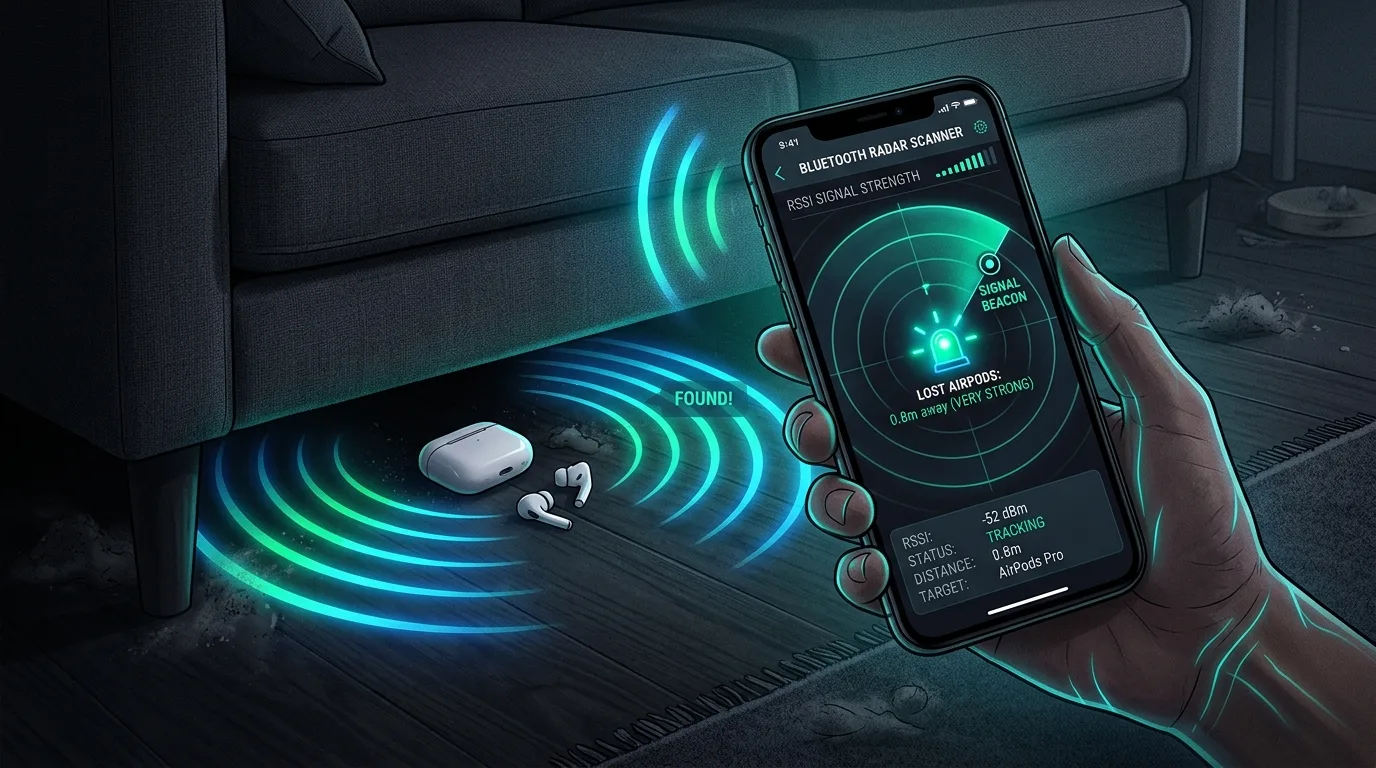
To find items indoors, you need to measure local radio frequency strength using Received Signal Strength Indicator (RSSI). Because Bluetooth Low Energy (BLE) transmitters broadcast signals continuously while powered on, your smartphone can measure signal intensity in decibel-milliwatts (dBm) to guide you directly to the target.
Understanding Bluetooth RSSI: The Decibel Scale
RSSI is measured in negative numbers. The closer the number is to zero, the stronger the signal and the closer you are to the lost item:
| RSSI Value (dBm) | Signal Quality | Approximate Range | Recommended Action |
|---|---|---|---|
| -30 to -50 dBm | Maximum Strength | Within 1 to 3 feet | You are right on top of it. Check under cushions, blankets, and bags. |
| -55 to -70 dBm | Strong Signal | Within 5 to 15 feet | Same room. Walk slowly in a grid pattern to see if dBm rises. |
| -75 to -85 dBm | Moderate Signal | Adjacent room / 20 to 30 feet | Move toward adjoining rooms or check behind walls. |
| -90 to -100 dBm | Faint Signal | Outer perimeter / 40+ feet | Walk through the house to pick up a stronger broadcast. |
The 4-Step Hot and Cold Hunting Technique
- Turn on Bluetooth and open a radar scanner: Launch a dedicated BLE signal tracker like FindMy Device to scan the 2.4 GHz frequency band for active broadcasts.
- Select your target hardware: Identify your device from the discovered BLE list (such as AirPods, Apple Watch, Galaxy Buds, Tile, or Fitbit).
- Walk in a slow, deliberate circle: Bluetooth signals fluctuate due to physical obstacles (human bodies, furniture, walls). Hold your phone steady at chest height and take slow steps in one direction for 5 seconds.
- Watch the proximity meter fill up: If the signal drops from -75 dBm to -60 dBm, you are getting warmer. When the radar hits -40 dBm, start searching physical crevices, pockets, and under furniture.
Common Physical Obstacles That Distort Signals
Bluetooth waves operate at 2.4 GHz, the same frequency absorbed by water and dense materials. Keep these real-world factors in mind during your search:
- Human Bodies: Water absorbs 2.4 GHz radiation. Holding your phone behind your back can artificially reduce signal strength by 10 to 15 dBm.
- Metal Furniture and Refrigerator Doors: Metal creates signal reflections and dead zones. If you suspect an earbud is in the kitchen, step around metal appliances.
- Closed Cases: If both AirPods are inside a closed non-smart case, the broadcast is heavily attenuated. If even one earbud is out of the case, it broadcasts at full power.
Pro Tip: Play High-Pitch Audio
Once your RSSI meter confirms you are within three feet of the device, trigger an audible chime through the tracker to pinpoint the exact hiding spot by sound.
Locate Lost Electronics in Seconds
Rather than tearing apart your living room or paying $70+ for replacement hardware, an on-device radar like FindMy Device: Bluetooth Tracker turns your phone into an intuitive proximity scanner with instant distance estimates and sound triggers.
Bluetooth RSSI Signal & Distance Triangulation Simulator
Estimate physical distance to lost AirPods or Bluetooth beacons using the Log-Distance Path Loss equation.