
Step onto the scale right before climbing into bed at night, and then weigh yourself again immediately upon waking up. Almost without exception, the scale reveals that you are 0.5 to 1.5 kilograms (1.0 to 3.3 pounds) lighter. This daily phenomenon leads many to wonder: did you actually burn off two pounds of pure body fat while resting under the covers?
Executive Summary & Research Finding
Why do you weigh less in the morning? Learn the exact science of overnight weight loss: exhaled carbon dioxide, respiratory water loss, and deep-sleep fat oxidation.
The short answer is both fascinating and grounded in biochemistry. While a portion of overnight scale loss represents true adipose fat oxidation driven by human growth hormone, the majority is a combination of insensible respiratory water evaporation and the literal exhalation of carbon atoms through normal breathing.
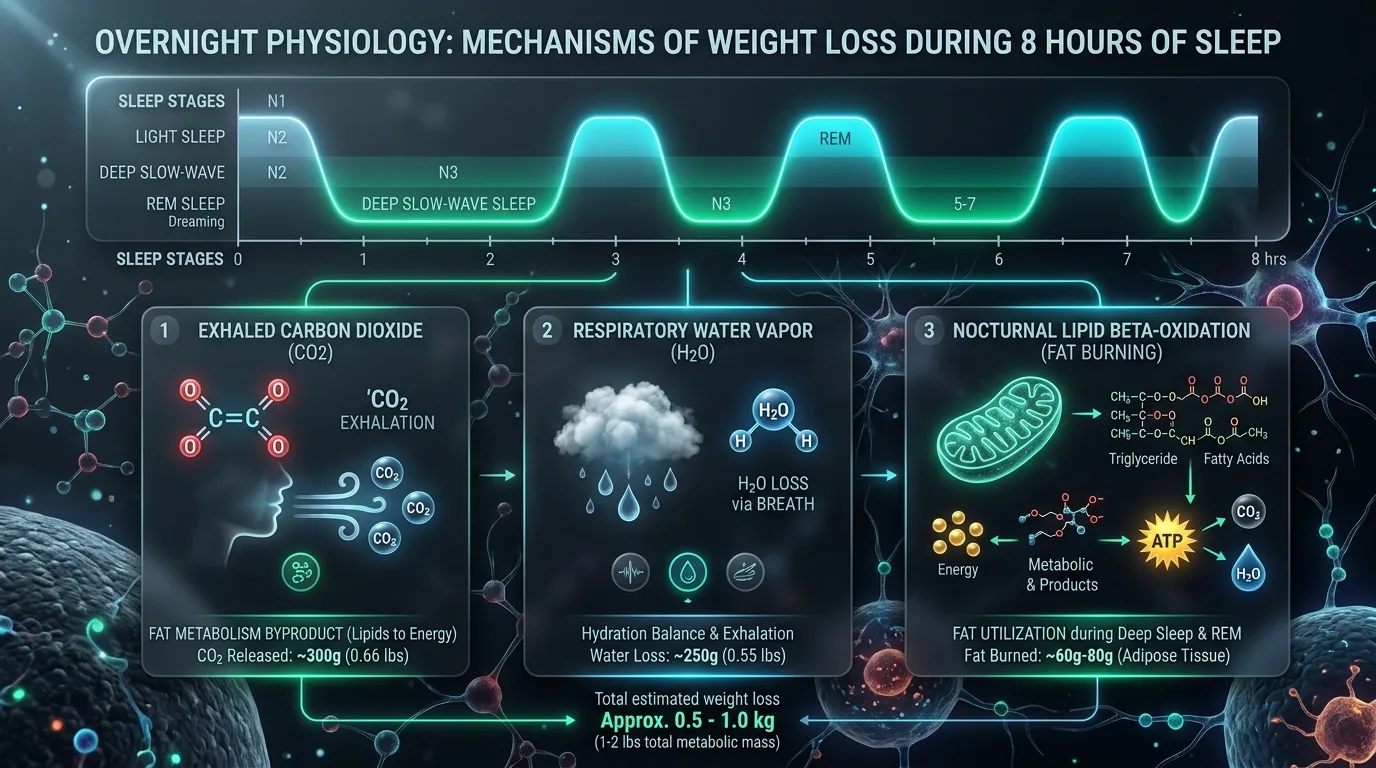
The 3 Biological Mechanisms of Overnight Weight Loss
Over an 8-hour sleep period, your body loses mass through three distinct physiological pathways:
| Loss Pathway | Average Overnight Mass Loss | Primary Biological Driver | Is It True Fat Loss? |
|---|---|---|---|
| Insensible Water Loss | 300 – 700 g (0.7 – 1.5 lbs) | Respiratory humidity & transepidermal perspiration | No (Hydration Fluctuation) |
| Carbon Dioxide ($CO_2$) Exhalation | 120 – 180 g (0.26 – 0.40 lbs) | Cellular respiration of glucose and fatty acid carbons | Yes (Mass Loss from Substrate Burn) |
| Nocturnal Lipid Oxidation | 40 – 65 g (400 – 580 kcal) | Basal metabolic maintenance & cellular repair | Yes (Pure Adipose Tissue Loss) |
1. Exhaling Carbon: The Landmark BMJ Study
Where does body fat actually go when it is burned? In a landmark paper published in the British Medical Journal (BMJ), physicists Ruben Meerman and Professor Andrew Brown tracked the exact atomic pathways of lipid metabolism.
When your body oxidizes a triglyceride molecule ($C_{55}H_{104}O_6$), the chemical reaction requires oxygen and produces carbon dioxide and water:
The Stoichiometry of Fat Loss
To burn 10 kg of human fat, you must inhale 29 kg of oxygen. The biochemical breakdown produces 28 kg of Carbon Dioxide ($CO_2$) and 11 kg of Water ($H_2O$). Exactly 84 percent of all burned fat is exhaled as gas through your lungs, while only 16 percent is excreted as urine, sweat, and moisture.
Every time you breathe in ambient air (O2, molecular weight 32) and breathe out carbon dioxide (CO2, molecular weight 44), you are expelling heavier gas than you inhaled. Over 8 hours of sleep (approx. 5,760 breaths at a resting respiratory rate of 12 breaths per minute), you exhale roughly 150 grams of pure carbon weight into the room.
2. Insensible Water Evaporation and Breath Humidity
Even in a climate-controlled bedroom with zero perceptible sweating, the body continuously loses moisture through two involuntary mechanisms documented by the National Center for Biotechnology Information (NCBI):
- Pulmonary Water Vapor: The air inside your alveoli is 100 percent saturated with water vapor at 37°C (98.6°F). With every exhalation, moisture is carried away into the dry room air (~200 to 350 mL).
- Transepidermal Water Loss (TEWL): Microscopic diffusion of water through the skin stratum corneum barrier (~150 to 300 mL).
Combined, this accounts for approximately 0.5 to 0.9 liters of fluid overnight. This explains why drinking a tall 500 mL glass of water upon waking immediately restores that portion of the scale drop.
3. The Science of Deep Sleep Lipolysis and Growth Hormone
While water accounts for the bulk of volume, sleep is when true metabolic repair occurs. Your brain, heart, liver, and cellular protein synthesis engines consume energy continuously (roughly 45 to 70 kcal per hour depending on body composition).
During Stage 3 NREM Deep Slow-Wave Sleep, the pituitary gland releases its largest daily surge of Human Growth Hormone (HGH). Growth hormone is strongly lipolytic: it signals adipocytes to liberate free fatty acids into circulation to fuel overnight tissue repair while sparing muscle glycogen.
Why Sleep Deprivation Destroys Fat Loss: The Clinical Evidence
What happens if you restrict sleep while trying to lose weight? A seminal clinical trial published in the Annals of Internal Medicine compared two groups on the exact same caloric deficit for 14 days:
| Metabolic Outcome | 8.5 Hours Sleep / Night | 5.5 Hours Sleep / Night | Clinical Impact |
|---|---|---|---|
| Fat Mass Lost | 1.4 kg (3.1 lbs) | 0.6 kg (1.3 lbs) | 55% Reduction in Fat Loss |
| Lean Muscle Mass Lost | 1.5 kg (3.3 lbs) | 2.4 kg (5.3 lbs) | 60% Increase in Muscle Breakdown |
| Ghrelin (Hunger Hormone) | Baseline Levels | Elevated by +28% | Severe cravings for sugar & refined carbs |
When you are chronically sleep-deprived, elevated nighttime cortisol and blunted growth hormone force your metabolism to burn valuable muscle protein instead of stored body fat. Getting 7.5 to 9.0 hours of quality sleep is literally half the battle of any body recomposition program.
3 Rules to Maximize Overnight Fat Oxidation
- Finish Dinner 3 Hours Before Bed: High circulating insulin from late-night carbohydrates suppresses hormone-sensitive lipase (HSL), preventing the body from tapping into stored fat during the first 4 hours of sleep.
- Keep Your Bedroom Cool (18°C – 20°C / 65°F – 68°F): Cooler ambient temperatures stimulate metabolic brown adipose tissue (BAT) thermogenesis and increase Slow-Wave Sleep depth according to the National Sleep Foundation.
- Track Daily Macronutrients Accurately: Ensuring adequate dietary protein (1.8–2.2 g/kg) provides the amino acid building blocks for nocturnal protein synthesis and prevents metabolic adaptation.
Recommended Tracking Tool
Use Calorie Counter: Meal Tracker App to easily log your evening macronutrients, schedule fasting windows, and ensure your daily energy deficit matches your metabolic recovery goals.
Overnight Weight Loss & Sleep Fat Burn Calculator
Calculate your exact morning scale drop broken down into exhaled carbon gas mass ($CO_2$), respiratory water vapor, and true deep-sleep adipose oxidation.
Overnight Mass Loss Composition:
90-Minute Sleep Cycle & REM Bedtime Calculator
Calculate optimal bedtimes and wake times aligned with 90-minute ultradian sleep cycles to wake up energized without grogginess.
Optimal Bedtime Options:
Resting Metabolic Rate & Inactive Daily Burn Calculator
Calculate how many calories your body expends 24/7 simply breathing, circulating blood, and maintaining vital organs while doing nothing.