One of the most frequent questions asked by newcomers to mindfulness and cognitive science is: 'How long do daily affirmations take to actually work?' Popular internet culture frequently parrots the myth that habits and mindsets transform in exactly 21 days. However, when people reach day 22 and still experience occasional bouts of anxiety or self-doubt, they conclude that affirmations are ineffective and quit.
The truth is grounded in the biological timeline of neuroplasticity and synaptic consolidation. Rewiring decades of automated negative neural pathways is a physiological process akin to building muscle tissue or learning a foreign language. Here is what peer-reviewed behavioral research actually reveals about the realistic week-by-week timeline of mental transformation.
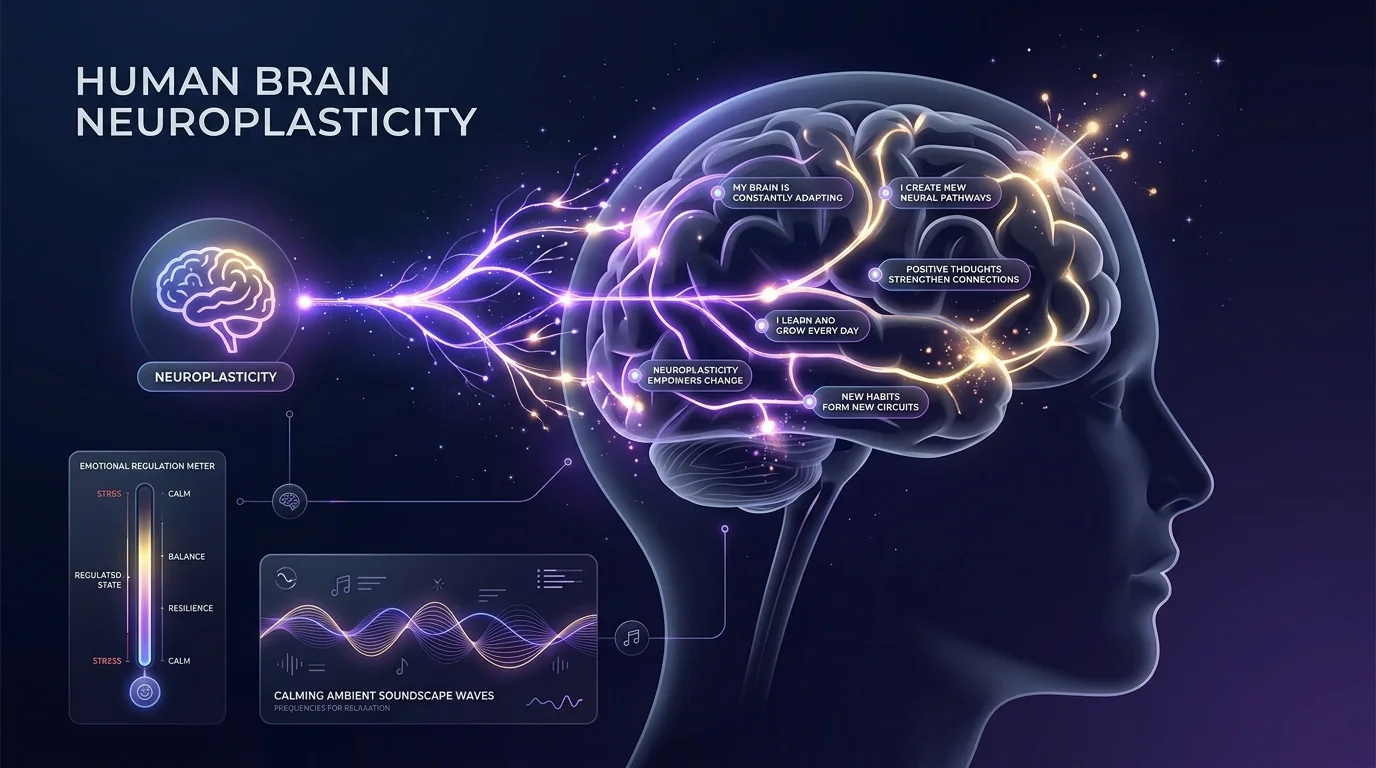
Why the 21-Day Habit Myth Is Scientifically False?
The widespread claim that changing your mindset takes 21 days originated from a misinterpretation of Dr. Maxwell Maltz's 1960 book Psycho-Cybernetics, where he observed that plastic surgery patients took a minimum of 21 days to adapt to their new facial appearance.
In 2009, Dr. Phillippa Lally and her research team at University College London (UCL) conducted the landmark empirical study on habit formation, published in the European Journal of Social Psychology. Tracking participants over 12 weeks, the researchers found that establishing automaticity requires an average of 66 days—with a range spanning from 18 to 254 days depending on cognitive complexity and emotional resistance.
The 12-Week Neuroplastic Transformation Roadmap
| Phase & Timeline | Neurological Event | Psychological Experience | Actionable Protocol |
|---|---|---|---|
| Days 1 – 7: Cognitive Friction | Acute cognitive dissonance; Default Mode Network resistance | Affirmations feel "fake," awkward, or untrue. Active self-criticism flares. | Use gentle "bridge" affirmations. Focus on consistency rather than intense belief. |
| Days 8 – 21: Reticular Priming | Reticular Activating System (RAS) shifts selective attention filters | You begin catching negative rumination loops faster; moments of sudden clarity. | Add lock screen widgets; pair affirmations with morning hydration or walking. |
| Days 22 – 45: Synaptic Consolidation | Long-Term Potentiation (LTP); increased dendritic spine density | Emotional reactivity dampens. Challenging situations provoke less acute panic. | Expand affirmation categories to career goals, boundaries, and relationship healing. |
| Days 46 – 66: Myelination & Default Shift | Myelin sheath thickens around new prefrontal neural pathways | Positive self-talk becomes the automated default reflex under pressure. | Solidify long-term identity statements; practice gratitude micro-journaling. |
| Days 67+: Permanent Cognitive Resilience | Structural neuroplastic adaptation; altered baseline resting-state connectivity | Unshakable self-compassion, emotional equilibrium, high self-efficacy. | Maintain passive reinforcement with daily widgets and seasonal intention setting. |
What Is Long-Term Potentiation (LTP) in the Brain?
When you repeat a positive affirmation, specific neurons in your ventromedial prefrontal cortex and anterior cingulate fire in sequence. When this sequence is triggered daily, the synaptic junction between those neurons undergoes Long-Term Potentiation (LTP):
- Increased Neurotransmitter Sensitivity: The postsynaptic neuron sprouts additional AMPA and NMDA glutamate receptors, making it much easier for the signal to jump the synaptic gap.
- Myelin Insulation: Oligodendrocytes wrap layers of fatty myelin insulation around the axon, accelerating electrical conduction speeds by up to 100 times.
- Automated Highway: Over 60+ days, what began as an overgrown, effortful mental trail transforms into an eight-lane cognitive superhighway.
What Happens If You Miss a Day or Two?
One of the most encouraging findings from Dr. Lally's UCL study was that missing a single day does not reset your habit progress. Habit automaticity is an aggregate trajectory, not an all-or-nothing test. As long as you return to your practice promptly, your neuroplastic pathways continue consolidating.
The Frictionless Habit Principle
Behavioral scientist James Clear emphasizes that the primary barrier to long-term habit formation is friction. Placing positive affirmations directly onto your iPhone lock screen removes 100% of the cognitive friction required to remember your daily practice.
How Lumio Helps You Cross the 66-Day Threshold?
Consistency is the secret ingredient of neuroplasticity. With Lumio: Daily Affirmations, you receive gentle daily push notifications, aesthetic lock screen and home screen widgets, and built-in streak tracking that keep you motivated and accountable until positive self-talk becomes your permanent subconscious reflex.
Caffeine Half-Life & Sleep Disruption Calculator
Calculate how much active caffeine remains in your bloodstream at bedtime ($5.5 ext{h}$ elimination half-life) and find your exact last safe coffee cutoff time.
Bloodstream Concentration Decay Timeline:
90-Minute Sleep Cycle & REM Bedtime Calculator
Calculate optimal bedtimes and wake times aligned with 90-minute ultradian sleep cycles to wake up energized without grogginess.
Optimal Bedtime Options:
Habit Formation & RAS Priming Tracker
Calculate your neuroplasticity consolidation milestones based on cognitive psychology research.