Few psychological violations are as visceral or destabilizing as discovering that a surface you trusted for complete personal privacy is actually a transparent window for secret observers. In hotel suites, Airbnb bathrooms, fitting rooms, spa dressing areas, and rental accommodations, the mirror is an absolute psychological blind spot. We undress, inspect our appearance, groom ourselves, and engage in deeply private physical moments inches away from large glass panes—assuming that the glass is an impenetrable silvered barrier.
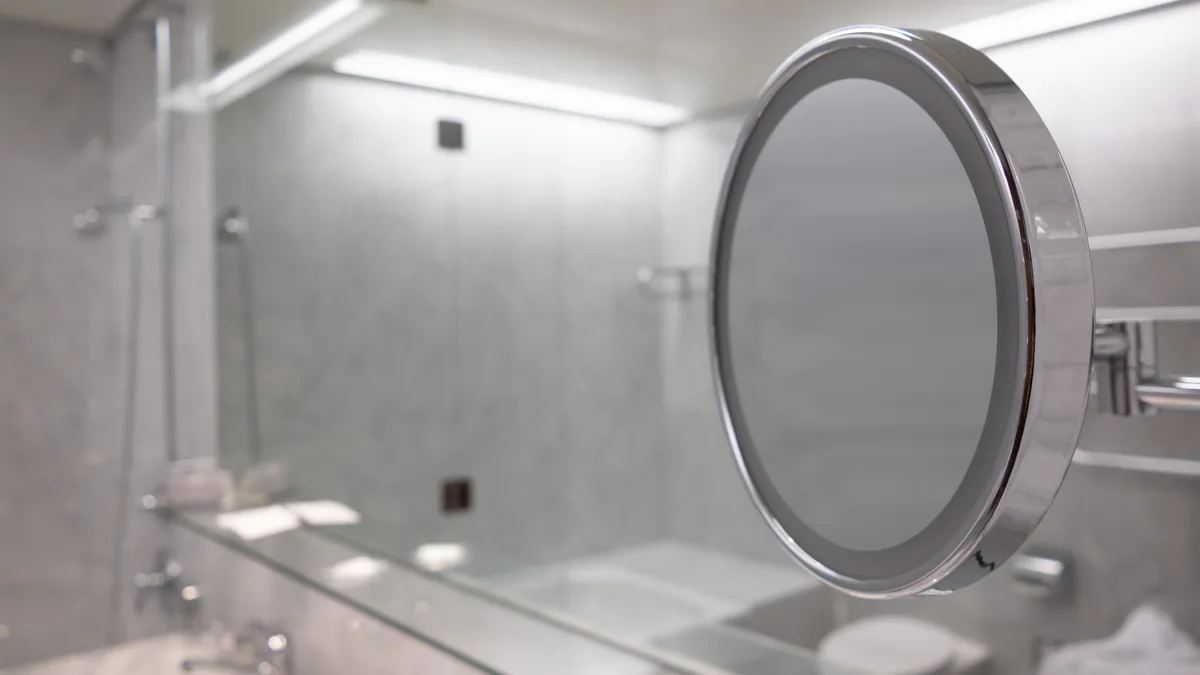
Yet, the history of commercial hospitality and voyeuristic criminal investigations proves that two-way mirrors (also known as transparent mirrors or observation mirrors) are an enduring, documented surveillance threat. Unlike a miniature pinhole lens hidden in an alarm clock—which captures only a limited field of view—a full-sized observation mirror offers an unhindered, panoramic vantage point of an entire room.
Fortunately, two-way mirrors are constrained by immutable physical laws of optical reflectance, transmission coefficients, and structural acoustic resonance. By understanding the physics of glass manufacturing and utilizing sensor fusion tools like Hidden Camera Detector App, any traveler or shopper can definitively certify whether a mirror is a harmless household fixture or an active surveillance portal in under thirty seconds.
The Optical Law of Two-Way Glass
A two-way mirror is not magic; it is an optical beamsplitter that transmits roughly 30% to 50% of incident light while reflecting the rest. It functions as an observation window only when the observed room is brightly lit and the observer's room is completely dark. If you eliminate the lighting imbalance or peer through with high-intensity light, the mirror effect is physically destroyed.
The Physics of Mirrors: Second-Surface vs. First-Surface vs. Beamsplitters
To understand why the famous fingernail test works—and where it occasionally fails—you must understand how different mirrors are manufactured:
1. Standard Second-Surface Household Mirrors (The Common Mirror)
Over 99% of all residential, hotel, and commercial bathroom mirrors are second-surface mirrors. In this design, high-grade float glass (typically 3mm to 6mm thick, with a refractive index n ≈ 1.52) serves as a transparent protective substrate. A micro-thin layer of metallic silver or aluminum is chemically deposited onto the back surface of the glass. Finally, that reflective metal film is sealed with an opaque, lead-free protective lacquer paint to prevent oxidation and physical scratching.
Because the reflective silvering is on the second surface, any incident light must travel through the thickness of the glass, bounce off the rear silver layer, and pass back out through the front glass plane.
2. Two-Way Observation Mirrors (Dielectric Beamsplitters)
A two-way mirror (often called a half-silvered mirror or Gesell sheet) lacks the thick, opaque protective paint backing entirely. Instead, a semi-reflective metallic or dielectric coating—such as titanium dioxide, silicon, or extremely thin vaporized aluminum—is applied directly to the glass.
This coating is engineered with a specific transmission-to-reflection ratio (typically 70% reflection / 12% transmission or 50% reflection / 50% transmission). When installed in a wall between two rooms, anyone in the brightly lit room sees only their own bright reflection, as the weak light leaking through from the dark room is completely overwhelmed by the reflected glare.
3. First-Surface Precision Optical Mirrors
In first-surface mirrors, the reflective metal coating is applied directly to the front exterior face of the substrate. There is zero glass between the observer and the metal film. These specialized mirrors are used in astronomical telescopes, laser projection optics, SLR camera viewfinders, and commercial dentist tools because they eliminate dual-surface ghosting (internal chromatic refraction).
| Mirror Type | Reflective Layer Location | Rear Coating | Fingernail Gap Result | Light Transmission | Common Applications |
|---|---|---|---|---|---|
| Standard Second-Surface | Rear of glass plate (under 3-6mm glass) | Opaque grey/green protective paint | Clear 1/8" Optical Gap | 0% (100% Opacity) | Bathrooms, bedrooms, home vanity, hotel rooms |
| Two-Way Observation Mirror | Front surface or laminated core | None (Clear or tinted glass) | ZERO Gap (Direct Touch) | 10% - 50% Transmission | Interrogation rooms, covert observation stalls, teleprompters |
| First-Surface Optical | Front exterior surface | Substrate backing (metal/glass) | ZERO Gap (Direct Touch) | 0% (Solid backing) | Lasers, telescopes, dental tools, prison security panels |
| Acrylic Safety Mirror | Front or rear of polycarbonate | Opaque or adhesive foam | Variable (Often Zero Gap) | 0% (Opaque plastic) | Gyms, fitness dance studios, childcare centers, schools |
Method 1: The Fingernail Gap Test (Execution & Scientific Analysis)
The fingernail gap test is the most widely recommended tactile counter-surveillance technique in the world. It requires zero tools, takes five seconds, and provides immediate physical insight into the mirror's optical geometry.
How to Perform the Test Step-by-Step
- Position Your Fingernail: Place the clean tip of your index fingernail perpendicularly against the polished surface of the mirror.
- Observe at an Acute Angle (45°): Do not look dead-center into the mirror. Lean your head to the side and inspect the point where your physical fingernail contacts the glass at a 45-degree angle.
- Analyze the Reflection Point:
- SCENARIO A — Visible Optical Gap (Safe): If there is a noticeable gap of approximately 1/8 inch (3mm to 6mm) between your physical fingernail tip and the reflected fingernail tip, the mirror is an authentic second-surface mirror. The reflective silvering is safely behind a thick sheet of glass. It is physically impossible for anyone to be viewing you through that solid opaque silver backing.
- SCENARIO B — Zero Gap (Direct Touch / Suspect): If your physical fingernail tip directly touches the tip of its reflection with zero perceptible gap (tip-to-tip contact), the reflective coating is on the very surface you are touching. This is a primary indicator of a two-way observation mirror.
Critical False Positive Warning: Acrylic & Safety Mirrors
Do not panic immediately if a mirror shows zero gap! Modern commercial fitness gyms, dance studios, public schools, and budget hotel bathrooms frequently install lightweight, shatterproof acrylic or polycarbonate mirrors to prevent dangerous glass shattering liabilities. Many acrylic mirrors utilize front-surface metallization or thin plastic sheets that produce zero gap despite being mounted on solid drywall. Always verify with the Flashlight Test and Acoustic Tap Test before drawing conclusions.
Method 2: The Flashlight Blackout Trick (Killing the 10:1 Light Ratio)
While the fingernail test detects surface geometry, the flashlight blackout trick is the definitive optical test that proves or disproves transparency. It exploits the fundamental vulnerability of all semi-transparent observation glass: the dependence on lighting imbalance.
Why the 10:1 Ratio Matters
In professional surveillance installations, two-way mirrors rely on the Contrast Masking Effect. The observed guest room is illuminated at 300 to 500 lux (bright overhead vanity lighting), while the secret viewing booth behind the wall is kept in pitch darkness (below 5 lux). The human eye inside the bathroom is overwhelmed by the reflected light and cannot register the faint 10% transmission coming from the dark room behind.
If you invert or equalize that lighting ratio, the mirror's reflective camouflage completely dissolves.
The 4-Step Flashlight Penetration Procedure
- Extinguish All Bathroom / Room Lights: Turn off overhead vanity lights, lamps, and adjacent room lights. Make the room as dark as possible.
- Activate Your Smartphone Flashlight: Turn on your smartphone's high-intensity LED torch (or a dedicated inspection flashlight).
- Press the Light Directly Flush Against the Glass: Hold the flashlight bezel directly against the mirror surface.
- Cup Your Hands to Form an Optical Seal: Place your face and hands tightly around the perimeter of the flashlight, creating an opaque dark tunnel that prevents escaping light from reflecting into your eyes. Peer directly into the illuminated spot.
The Verdict: If the mirror is authentic second-surface glass, you will see only an intense, blinding white glare against solid grey or silver paint. If it is a two-way observation mirror, your flashlight beam will punch directly through the semi-transparent coating, brightly illuminating the hidden cavity, adjoining corridor, structural framing, or camera lens positioned on the other side.

Scan for Electronics Behind Mirrors
Can't see through the glass? Use your smartphone's magnetic magnetometer to detect active camera processors, monitors, and power supplies hidden inside the wall.
Method 3: The Acoustic Knuckle Tap & Resonance Test
Sound propagation reveals what human vision cannot penetrate. Because standard household mirrors are decorative fixtures, they are mounted flush against solid residential building materials: drywall backed by wood studs, plaster over brick, or concrete masonry.
Conversely, a two-way mirror requires an open physical cavity or unoccupied room behind the wall to accommodate the observer or surveillance camera rigging. This architectural void creates a distinct acoustic Helmholtz resonator.
How to Perform the Tap Test
- Knuckle Tap on the Mirror: Gently tap your knuckles against the glass in the center and near the four corners.
- Knuckle Tap on an Adjacent Solid Wall: Tap on the painted drywall or tile wall immediately beside the mirror to establish a baseline acoustic frequency.
- Compare the Sound Signature:
- Dull, High-Frequency Thud: Indicates the mirror is firmly backed by solid drywall, adhesive mastic, or structural studs. This is characteristic of safe, normal installations.
- Hollow, Reverberant Drum-Like Echo: Indicates a significant open air void or chamber directly behind the glass pane. While some recessed medicine cabinets also sound hollow, any large vanity mirror with a hollow acoustic profile demands immediate optical and electronic verification.
Method 4: Architectural & Mounting Clues (Hanging vs. Embedded)
Examine the physical mounting architecture of the mirror. Standard commercial mirrors are manufactured as standalone furnishings and mounted onto finished wall surfaces using standard hardware:
- Visible Wall Hanging Brackets & Cleats: Look behind the edges of the mirror. If you can slide a sheet of paper or a credit card behind the frame, or if you can see a standard French cleat, wire hanger, or J-channel holding the mirror away from the wall, it is a normal hanging mirror. A two-way observation mirror cannot have an opaque wall directly behind its frame.
- Flush-Embedded Wall Cutouts: If the mirror is framed flush into the drywall partition—resembling a framed picture window rather than a hanging item—and shares an adjoining wall with a maintenance closet, utility room, or adjacent master suite, the architectural risk is significantly higher.
Method 5: Scanning Behind Mirrors with Hidden Camera Detector App
When optical and tactile inspections yield ambiguous results (such as with heavily tinted modern smart mirrors or LED-backlit vanity frames), electronic sensor fusion provides definitive verification. Modern covert surveillance behind mirrors involves electronic hardware: video cameras, image processors, local storage units, or wireless transmission bridges.
By leveraging the multi-sensor capabilities in Hidden Camera Detector App, you can audit the space behind a mirror without damaging property:
1. Hall-Effect Magnetometer Wall Sweeps
Every active electronic camera and power supply contains switch-mode inductors and electromagnetic transformers that emit localized magnetic flux fields. In standard construction, an unpowered glass mirror produces zero magnetic field (registering a baseline environmental reading between 30 µT and 45 µT).
Open the Magnetic EMF Scanner in Hidden Camera Detector App and slide your smartphone flush across the entire mirror surface in a serpentine raster grid. If a hidden camera or monitor is operating on the reverse side of the glass, the app's real-time microtesla gauge will spike violently (often exceeding 120 µT to 350 µT), accompanied by audible proximity beeping.
2. Optical Glint & Infrared Filter Sweeps
If a camera is positioned behind a two-way mirror, its glass camera lens must be aimed forward through the semi-transparent coating. Using the app's coaxial optical glint mode in complete darkness, sweep across the mirror from different angles. The camera's internal CMOS sensor array will retroreflect your smartphone's flash, revealing a pinpoint ruby-red or brilliant white optical glint glowing behind the tinted glass.
3. Local Subnet Wi-Fi Forensic Audit
If an observation camera is streaming live video to an off-site server or local host, it must transmit data. Launch the Local Network Scanner in the app while connected to the property's Wi-Fi. The scanner cross-references connected MAC addresses against known IoT camera hardware vendors (such as Hikvision, Dahua, Tuya, or generic IP cam chips), identifying rogue surveillance hardware active on the local subnet.
High-Risk Real-World Locations: Where Two-Way Mirrors Actually Occur
While urban legends exaggerate the prevalence of two-way mirrors in everyday standard hotel chains, criminal law enforcement records identify three specific commercial and residential sectors where observation mirrors have repeatedly been documented:
| High-Risk Environment | Primary Vulnerability Zone | Documented Threat Motive | Primary Verification Method |
|---|---|---|---|
| Independent Boutiques & Motels | Bathrooms sharing walls with maintenance closets | Rogue employee voyeurism / dark web streaming | Flashlight blackout test & magnetic EMF sweep |
| Private Vacation Rentals (Airbnb/Vrbo) | Master bedroom suites and pool changing cabins | Host voyeurism & predatory guest surveillance | Fingernail gap test & knuckle resonance tap |
| Retail Clothing Fitting Rooms | Changing cubicles backing into stockrooms | Unauthorized surveillance / illicit recording | Flashlight seal inspection on partition walls |
| Commercial Tanning Salons & Spas | Tanning bed enclosures & massage rooms | Unlawful commercial voyeurism rings | Acoustic tap test & camera glint inspection |
What to Do If You Discover a Two-Way Mirror or Hidden Camera
If your physical and electronic sweep confirms that a mirror is an active two-way observation window or conceals a covert recording device, follow this strict four-step operational protocol:
- Do Not Break or Vandalize the Glass: While your immediate emotional reaction may be anger, breaking the glass destroys physical and digital evidence and exposes you to civil property damage claims.
- Preserve Video Evidence of the Discovery: Use your mobile phone to record an unbroken, continuous high-definition video walkthrough. Start by filming the property address, room number, or store location, walk to the mirror, perform the fingernail test on camera, shine your flashlight through the glass to document the hidden room or camera lens, and capture the telemetry readings on Hidden Camera Detector App.
- Cover the Mirror Immediately: Hang a dark blanket, bath sheet, or opaque garment over the glass to block visual line-of-sight.
- Evacuate & Contact Law Enforcement: Exit the premises immediately. Do not confront retail staff, hotel clerks, or rental hosts alone. Dial municipal police emergency services and state clearly: 'I have uncovered an active two-way voyeuristic mirror and covert camera installation inside a private room at [Location]. I have documented video evidence and request a forensic officer on scene.'
Frequently Asked Questions: Two-Way Mirror Detection
What is the fingernail test on a mirror, and how does it work?
The fingernail test relies on the physical construction of standard second-surface household mirrors. In a normal mirror, the reflective silver or aluminum coating is sealed behind a 3mm to 6mm sheet of glass. When you place the tip of your fingernail against the surface, you touch the front of the glass, creating a distinct optical gap (typically 1/8 inch) between your nail and its reflection. In a two-way observation mirror, the reflective coating is applied to the front surface or integrated inside a beamsplitter, causing your fingernail to touch its reflection directly with zero optical gap.
Can a two-way mirror work if both rooms are brightly lit?
No. Two-way mirrors (dielectric beamsplitters) rely on a severe lighting imbalance—ideally a 10:1 or greater light ratio—to maintain the illusion of a mirror. The observed room (such as a bathroom or dressing stall) must be brightly illuminated, while the observation compartment or hidden room behind the glass must remain dark. If both rooms have equal lighting, or if you darken the observation room and shine a bright light against the glass, the mirror effect disappears, and both sides become transparently visible.
Are there normal mirrors that fail the fingernail test (false positives)?
Yes. First-surface optical mirrors—such as precision dental mirrors, telescope reflectors, laser optics, and certain polished metal or acrylic safety mirrors used in public gyms or prisons—have their reflective coating on the front surface to eliminate dual-refraction ghosting. Touching an acrylic safety mirror will show zero gap even though no one is watching from behind. To verify, always combine the fingernail test with the flashlight blackout trick and an acoustic knuckle tap test.
How does the flashlight test expose a two-way mirror?
To execute the flashlight test, extinguish all lights in your room, press your smartphone's high-intensity flashlight flush against the glass surface, and cup your hands tightly around the perimeter to block any escaping ambient glare. By flooding that localized section of the glass with intense direct light, you overcome the 10:1 light ratio, illuminating the dark cavity or secret room behind the mirror and revealing any hidden cameras, observation windows, or structural hollows.
Can a hidden camera record through a normal mirror?
A camera cannot record through a standard, genuine second-surface mirror because the rear silvering is completely backed by an opaque layer of protective lacquer and lead-free paint. However, voyeurs frequently scrape away a tiny 2mm circle of the silver backing on a standard mirror to create a peephole, or they install a full two-way semi-transparent mirror in place of the original vanity glass. Inspecting the surface with a flashlight will instantly highlight any scraped peepholes or semi-transparent sections.
How does a smartphone app detect electronic equipment behind a mirror?
Smartphone counter-surveillance tools like Hidden Camera Detector App utilize the phone's built-in Hall-effect magnetometer to measure localized electromagnetic field (EMF) flux. Active electronic devices—including video monitors, DVRs, covert camera processors, and switch-mode power converters hidden in wall cavities behind mirrors—emit distinct magnetic signatures (spiking above 100 µT). Sweeping your phone across the mirror surface allows you to detect hidden circuitry through the glass without damaging the wall.
Related Counter-Surveillance Guides
Recommended reading from the Hidden Camera Detection Cluster: