For infant sleep conditioning, pink noise is acoustically superior to pure white noise, but volume control is paramount. While white noise contains equal acoustic energy across all frequencies from 20Hz to 20,000Hz (producing a harsh 'hissing' static), pink noise attenuates higher pitches at a rate of 3 decibels per octave (1/f power density), closely mimicking maternal placental blood flow and uterine sounds. According to the American Academy of Pediatrics (AAP), sound machines must never exceed 50 dBA at the infant's ear level and should be positioned at least 7 feet (2 meters) away from the crib.
Executive Summary & Research Finding
White noise vs pink noise for infant sleep: AAP decibel limits, safe distances from the crib, frequency spectrum analysis, and audio baby monitor acoustic tracking.
The Acoustic Spectrum: White Noise vs Pink Noise vs Brown Noise
Understanding the physics of sound frequencies helps parents select soothing auditory backgrounds that promote slow-wave delta sleep without overstimulating the infant's developing cochlea.
| Acoustic Profile | Spectral Distribution | Real-World Sound Equivalent | Pediatric Calming Efficacy | Safe Decibel Range |
|---|---|---|---|---|
| White Noise | Equal power across all frequencies (flat 0 dB/octave) | Television static, radio static, air conditioner fan | Moderate; high-pitched hiss can trigger sensory agitation | 45–50 dBA maximum at crib |
| Pink Noise | Power drops by 3 dB per octave (inverse frequency 1/f) | Steady gentle rainfall, rustling leaves, rhythmic ocean waves | Highest; proven to stabilize slow-wave infant EEG sleep stages | 45–50 dBA maximum at crib |
| Brown / Red Noise | Power drops by 6 dB per octave (1/f² power density) | Distant rolling thunder, deep waterfall, low airplane rumble | Very soothing for hyper-arousal, but heavy bass can penetrate walls | 45–48 dBA maximum at crib |
| Vocal Shushing | Mid-frequency band emphasis (1000Hz - 3000Hz) | Human 'shhh-shhh' parental whispering | Immediate acute calming reflex (Dr. Karp 5 S's), but tiring to sustain | 50–55 dBA during acute soothing |
Step-by-Step: How to Measure and Set Safe Nursery Decibel Levels
- Position the sound emitter across the room: Never place a phone, speaker, or sound machine directly inside the crib or clipped onto the mattress rails.
- Maintain the 7-foot safety boundary: Keep the device at least 2 meters (7 feet) away from the infant's resting head position.
- Calibrate with a sound level meter: Place your smartphone microphone directly where your baby's head rests on the mattress.
- Test baseline volume: Turn on your sound machine and verify that the steady ambient reading does not exceed 50 dBA.
- Enable continuous acoustic monitoring: Ensure your baby monitor detects infant crying peaks above the ambient noise floor without false alarms.
Acoustic Warning: AAP Infant Hearing Guidelines
A clinical study published in Pediatrics tested 14 commercial infant sound machines at maximum volume placed within 1 foot of the crib. Every single unit exceeded 85 dBA — a level equivalent to heavy highway traffic that can cause permanent auditory threshold shifts if sustained for 8-hour sleep cycles. Always measure volume at the baby's pillow level.
How Does Continuous White Noise Mask Sudden Environmental Disturbance?
Infants do not wake up because a room is noisy; they wake up because of sudden changes in noise volume. In acoustics, this is called the Signal-to-Noise Ratio (SNR). If a nursery sits in dead silence at 30 dBA, a dog barking at 65 dBA creates an abrupt 35 dBA delta that triggers the infant's Moro reflex. By raising ambient background sound to a safe 48 dBA of steady pink noise, that same 65 dBA bark is perceived as a mild 17 dBA shift, allowing the infant to sleep smoothly through sleep cycle transitions.
How Can a Mobile Baby Monitor Eliminate the Need for Separate Sound Machines?
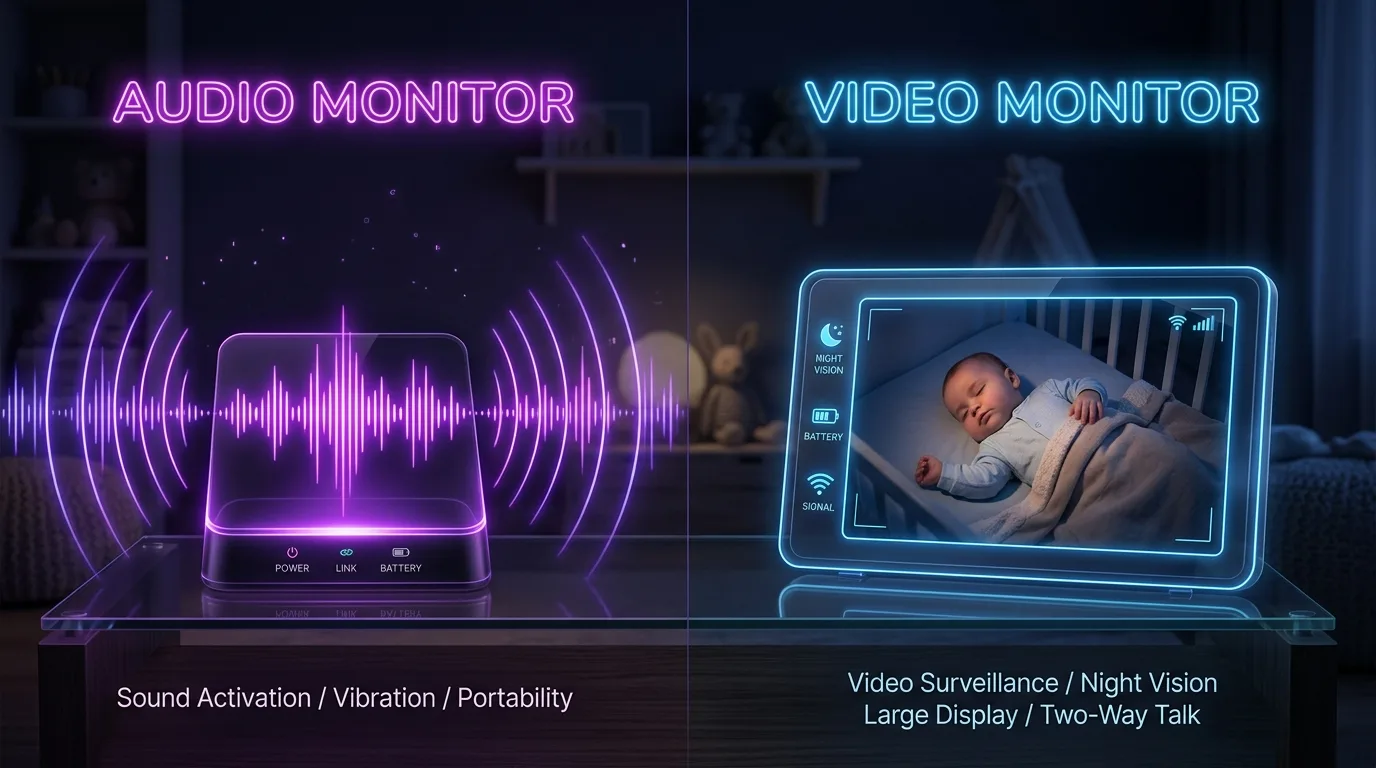
Modern parents often clutter the nursery with three redundant hardware gadgets: a $200 video camera, a separate $50 white noise machine, and an environmental thermometer. With Bambino Baby Monitor, a spare iPhone or iPad acts as both an HD video camera and an intelligent audio monitor. Bambino filters steady background white noise so you only receive alerts when your infant actually stirs or cries, while allowing you to play safe, calming lullabies and calibrated noise tracks directly through the remote device.