
Apple's iOS 20 represents the most radical architectural transformation in mobile operating system history. Moving far beyond reactive question-and-answer voice assistants, iOS 20 introduces Autonomous On-Device AI Agents, a re-architected Siri 2.0 powered by a distilled 7-billion-parameter local foundation model, and seamless cross-app task orchestration through the expanded App Intents 3.0 framework. However, executing multi-step autonomous workflows and hosting on-device neural weights locally requires up to 15GB to 25GB of local NAND storage, creating severe disk pressure for users on 128GB and 256GB devices.
Executive Summary & Research Finding
What's new in iOS 20 (2026/2027): Autonomous AI agents, Siri 2.0, on-device foundation models, storage bloat fixes, and new features explained.
The Architectural Overhaul: iOS 18/19 vs iOS 20 Compared
Apple Silicon's 16-core Neural Processing Unit (NPU) delivers over 45 TOPS of integer compute, enabling complex transformer attention mechanisms to run completely offline without round-tripping to cloud servers.
| System Subsystem | iOS 18 / 19 Legacy Architecture | iOS 20 Overhaul | NAND / RAM Footprint | Privacy & Offline Mode |
|---|---|---|---|---|
| Siri & AI Assistant | Rule-based routing with simple intent matching | Autonomous Agent with multi-step tool-calling and self-correction | 2.8GB RAM allocation during execution | 100% on-device; Private Cloud Compute for heavy tasks |
| Local Foundation Models | Quantized 3B parameter model for text summarization | 7B Mixture-of-Experts (MoE) model running on A18/A19/A20 NPU | 8GB–14GB stored locally in System Data | End-to-end encrypted with hardware Secure Enclave attestation |
| Action Orchestration | Single-action Siri Shortcuts triggered manually | Chained agentic actions across multiple third-party apps automatically | Negligible runtime footprint | Requires granular user consent for write actions |
| APFS Storage Management | Static application caching with delayed garbage collection | Dynamic neural vector caching with semantic photo index clustering | Up to 20GB extra 'System Data' overhead | Local APFS cache compression |
| Personal Context Index | Basic Spotlight indexing and photo metadata tags | Vectorized knowledge graph linking messages, calendar, mail, and notes | 2GB–4GB persistent vector database | On-device indexing; zero cloud logging |
The Hidden Cost: Why iOS 20's AI Models Devour Local Storage
While autonomous agents revolutionize smartphone productivity, their local footprint is substantial. In previous iOS releases, the operating system kernel and basic frameworks consumed roughly 10GB to 12GB of flash memory. In iOS 20, the local foundation model weights, tokenizers, quantized matrix buffers, and continuous multi-modal embeddings permanently claim an additional 12GB to 18GB of storage under the 'System Data' bar. If your iPhone has less than 20GB of free space before upgrading, system performance, app updates, and background NPU compilation will stutter.
The Neural Cache Bloat Hazard
iOS 20 generates on-device vector embeddings for every photo, note, and message you receive to allow Siri to search your personal context semantically. If your photo gallery contains 15,000 photos (including 3,000 blurry burst duplicates and accidental screenshots), the vector database swells exponentially. Cleaning out camera roll clutter directly frees up gigabytes of neural database overhead.
Step-by-Step: How to Prepare Your iPhone for iOS 20 and Free 20GB+ Fast
- Audit existing storage distribution: Navigate to Settings -> General -> iPhone Storage to verify how many gigabytes are consumed by 'Photos', 'Apps', and 'System Data.'
- Purge duplicate and burst photo series: Scan your camera roll to eliminate identical burst shots, keeping only the single crispest picture.
- Compress heavy 4K and 60fps video files: Identify multi-gigabyte video clips and compress them locally, reducing file size by up to 80% without noticeable mobile degradation.
- Empty the Recently Deleted quarantine: Open the Photos app, authenticate with Face ID in 'Recently Deleted', and tap 'Delete All' to release held NAND blocks.
- Consolidate contacts and address book cards: Merge duplicate contacts and remove obsolete ghost numbers so iOS 20's Personal Context Index remains lean and lightning-fast.
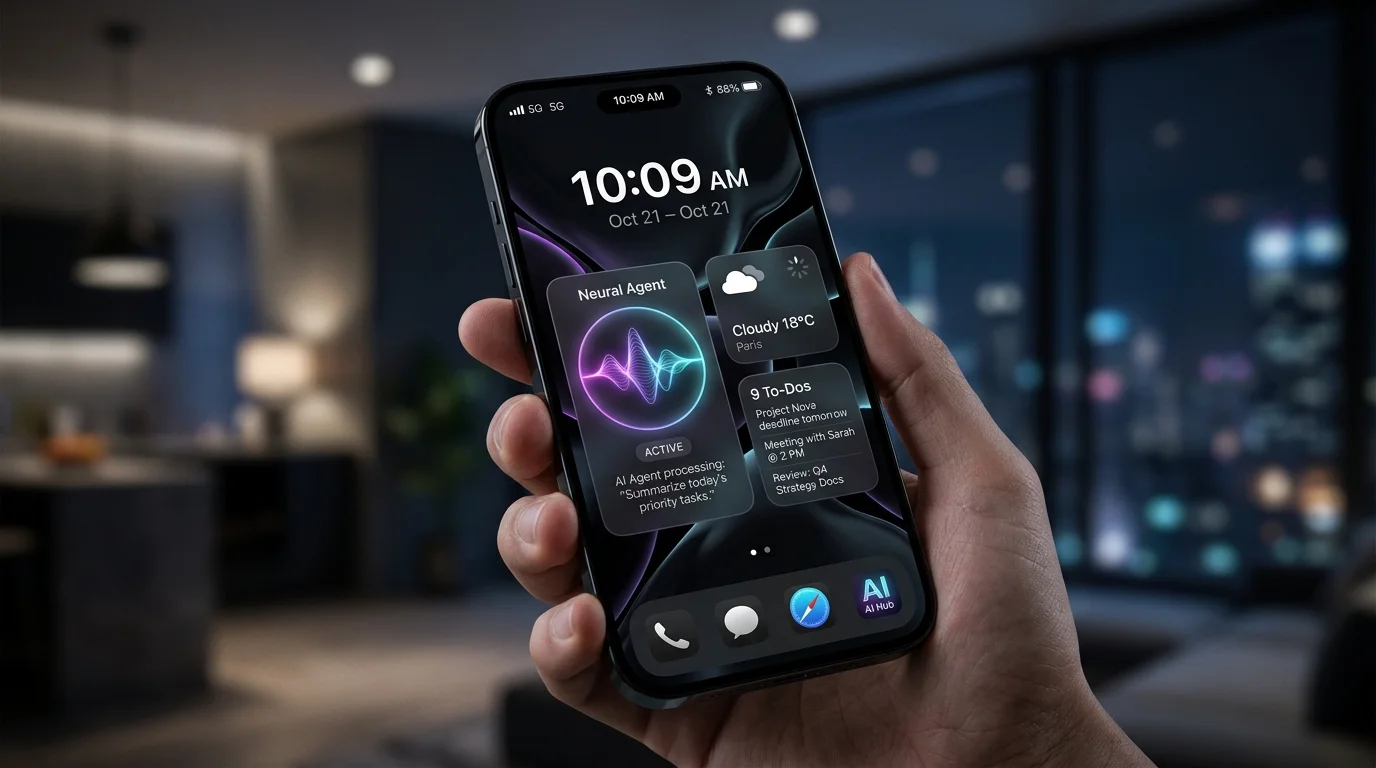
How Do Autonomous AI Agents Actually Execute Multi-Step Workflows?
Unlike older voice assistants that could only execute one direct command at a time ('Set a timer for 10 minutes'), iOS 20's autonomous agent engine uses chain-of-thought planning. For example, if you say: 'Find the receipt Sarah emailed me yesterday, calculate my half of the dinner, and send her $45 on Apple Pay,' Siri 2.0 performs three sequential tool calls: first querying the local Mail vector index, parsing the PDF receipt using on-device OCR, calculating the split, and opening Apple Pay with the pre-filled amount awaiting your Face ID authentication.
How Does Clearly Storage Cleaner Maximize Your iPhone's Performance on iOS 20?
To take full advantage of iOS 20's on-device AI models without buying a new phone, keeping your local storage lean is non-negotiable. Clearly Storage Cleaner is engineered specifically for modern iOS architectures. With intelligent duplicate photo scanning, powerful video compression that shrinks gigabyte-sized clips by 80%, and automated address book cleanup, Clearly reclaims 15GB to 35GB of storage in seconds. Keep your iPhone blazing fast and ready for next-generation AI with Clearly.
iOS 20 AI Foundation Model & Storage Impact Calculator
Estimate how many gigabytes of on-device neural model weights, autonomous agent context buffers, and system caches iOS 20 requires on your iPhone.