Few privacy violations feel more invasive than the thought of being observed through a bathroom or changing room mirror. Stories of two-way observation glass in vacation rentals, fitting rooms, and boutique accommodations circulate widely across social media. But how can an everyday traveler distinguish a standard vanity mirror from covert two-way observation glass?
Executive Summary & Research Finding
Learn how to detect two-way mirrors in hotel bathrooms, Airbnbs, and changing rooms. Master the fingernail test, flashlight method, and lighting physics.
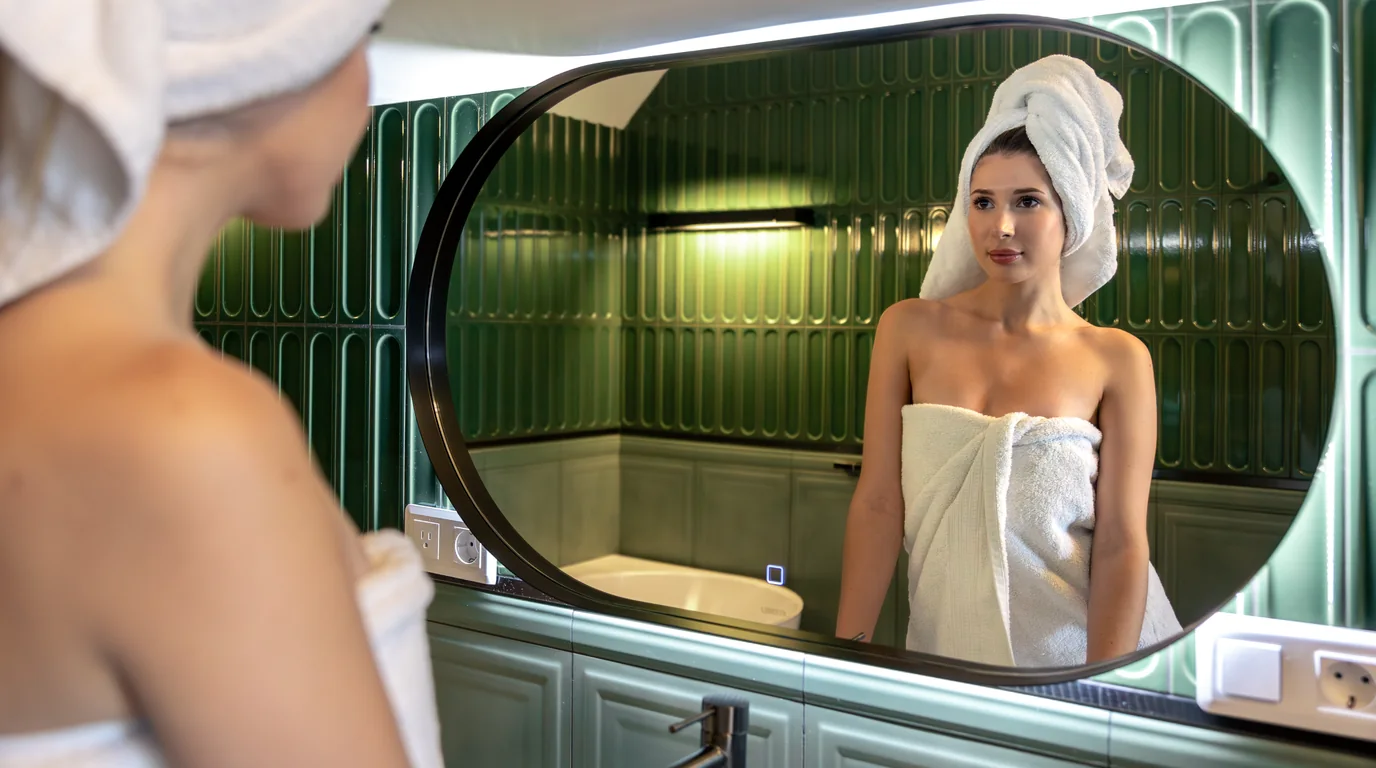
The good news is that two-way mirrors operate on strict optical principles: they require a semi-reflective micro-coating and a significant light imbalance between two adjacent rooms. By applying three fast physical diagnostic tests, you can determine with 100% certainty whether a mirror is safe.
How Two-Way Mirrors Actually Work: Physics & Light Ratios
A regular household mirror is a second-surface mirror: reflective silvering or aluminum is applied to the back of a thick sheet of glass. When you touch the surface, your finger touches the front of the glass, while the reflection occurs at the back coating, creating a visible 1/4-inch gap.
In contrast, a two-way mirror (technically a semi-transparent beam splitter) has a very thin, sparse reflective coating applied to the front surface or embedded within the glass. For a two-way mirror to function as a surveillance tool, two physical conditions must exist:
- 1. A Darkened Hidden Observation Room: The space behind the mirror must be significantly darker than the subject room (typically an 8:1 to 10:1 light ratio). The subject sees only the bright reflection of their own room, while an observer in the dark space looks directly through the semi-transparent glass.
- 2. Hollow Wall Cavity or Recessed Alcove: A two-way mirror cannot simply hang flat on a drywall partition; there must be an accessible viewing cavity, adjoining closet, or hidden maintenance crawlspace directly behind the wall.
The 3 Definite Physical Diagnostic Tests
- Test 1: The Fingernail Gap Test: Place the tip of your fingernail against the reflective mirror surface. On a normal mirror, there is a clear physical gap (approx. 3mm to 6mm) between your real nail and its reflection. If your fingernail tip touches its reflection tip-to-tip with zero gap, you may be looking at a first-surface mirror or two-way glass.
- Test 2: The Flashlight Cup Test: Turn off all bathroom lights. Press the flashlight of your smartphone flat against the mirror glass and cup your hands tightly around the perimeter to block ambient light. If it is a two-way mirror, the beam will illuminate the hidden cavity on the other side, allowing you to clearly see open space, shelving, or recording equipment.
- Test 3: The Knuckle Acoustic Knock Test: Gently tap your knuckles across different sections of the mirror. A standard wall-hung mirror produces a dull, solid thud because it rests flat against a drywall backing. A two-way mirror built into a partition produces a hollow, resonant echo indicating open air behind the glass.
| Mirror Characteristic | Standard Second-Surface Mirror | Two-Way Observation Glass |
|---|---|---|
| Fingernail Gap | Visible 3mm - 6mm gap | Zero gap (touches tip-to-tip) |
| Flashlight Cupped Test | Only reflects bright glare back | Reveals dark room / cavity behind glass |
| Acoustic Knock Sound | Dull, solid flat thud | Hollow, resonant acoustic echo |
| Mounting Style | Hung with brackets / wire on wall | Built permanently flush into wall aperture |
| Adjoining Wall Inspection | Solid drywall on reverse side | Adjacent locked closet or utility space |
Full Room Sweep with Hidden Camera Detector
Even if a bathroom mirror is a standard one-surface glass pane, voyeurs frequently mount microscopic pinhole cameras in adjacent fixtures to achieve an indirect viewing angle. After performing the mirror test, run Hidden Camera Detector App to sweep bathroom tissue dispensers, ventilation fans, and decorative wall sconces for rogue RF transmitters and magnetic signatures.
Frequently Asked Questions
Does the fingernail test always mean a mirror is two-way?
Not always. Some modern high-end architectural mirrors use front-surface coatings or optical acrylic to eliminate chromatic ghosting. If a mirror has no gap, always verify with Test 2 (Flashlight Cup) and inspect the opposite side of the wall before jumping to conclusions.
What should I do immediately if I confirm a two-way mirror?
Do not confront hotel staff alone. Cover the glass immediately with a bedsheet or towel, record video documentation showing the flashlight cupped test, and contact local police alongside the booking platform (Airbnb/Booking.com) to initiate an emergency security incident.
Hotel & Airbnb Privacy Safety Score Assessment
Complete this interactive 5-point inspection checklist to evaluate your room's surveillance risk index.