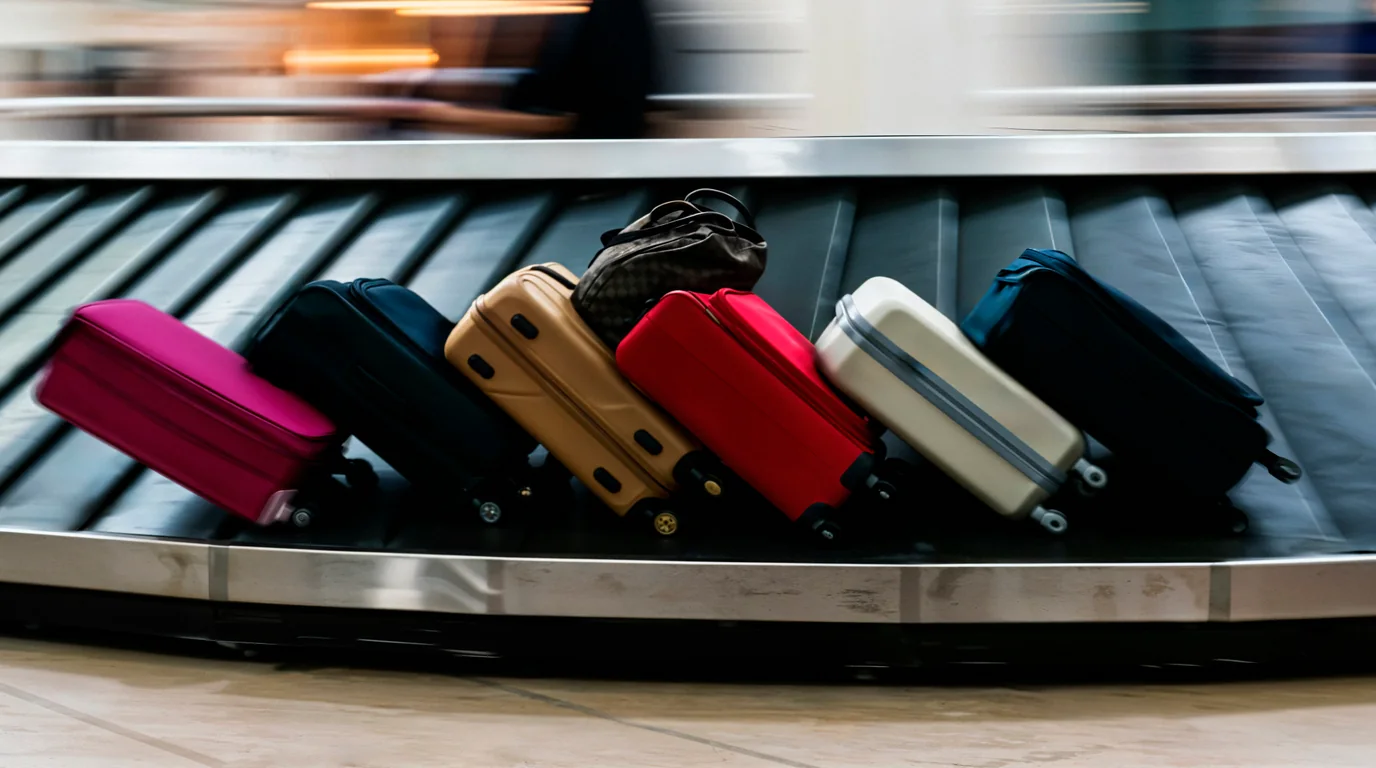
After a grueling 10-hour flight, nothing tests traveler patience like the airport baggage claim. Hundreds of exhausted passengers crowd around a noisy metal carousel, craning their necks at dozens of identical black hardshell suitcases tumbling out of the rubber chute. Watching people awkwardly grab the wrong bag only to put it back is a universal airport ritual.
Executive Summary & Research Finding
Airport baggage claim hacks: how to use Bluetooth trackers and proximity radar to identify your suitcase the second it arrives on the baggage carousel.
While travelers increasingly slip Bluetooth trackers (like AirTags, SmartTags, Chipolo, or Tile) into their luggage, waiting for GPS map pins to update inside a cavernous concrete airport terminal is slow and imprecise. By switching to live Bluetooth RSSI proximity radar, you can relax in a comfortable seat 40 feet away and know the exact second your bag slides onto the belt.
The Ultimate Airport Hack
Don't fight the crowd at the luggage belt. Launch Sweep: Find My Device, sit comfortably at a nearby bench, and watch the radar meter. The moment the reading jumps above -70 dBm, your bag has arrived.
Why GPS Maps Fail at Baggage Claim
Standard consumer tracking networks rely on crowd-sourced relays and cellular/GPS geolocation. Deep inside airport basements surrounded by reinforced concrete and steel conveyor systems, GPS satellite signals cannot penetrate. Cloud map updates can lag by 5 to 15 minutes. In contrast, local peer-to-peer Bluetooth Low Energy scanning operates instantly at the speed of light.
The Relaxed Traveler's Baggage Claim Playbook
| Timeline / Stage | Action | Radar Indicator | Traveler Advantage |
|---|---|---|---|
| Plane Deplaning | Walk to baggage claim hall | No signal (< -100 dBm) | Zero stress; grab coffee or use restroom first |
| Luggage Unloading | Sit on bench 30-40 feet from carousel | Signal appears at -85 dBm | Bag is being unloaded from tarmac cart behind sorting wall |
| Carousel Arrival | Bag rolls through the rubber flaps | Signal surges to -65 dBm | Stand up and walk calmly to the belt |
| Belt Retrieval | Bag reaches your exact standing position | Signal spikes to -45 dBm | Grab your confirmed suitcase with 100% confidence |
Top Luggage Tracking Devices Supported
- Apple AirTag & Find My Compatible Tags: Eerily accurate when paired with high-frequency BLE scanning.
- Samsung Galaxy SmartTag2: Exceptional long-range BLE transmission with rugged casing.
- Chipolo ONE & CARD: Super-slim credit card trackers ideal for laptop sleeves and luggage tags.
- Tile Pro & Mate: Standard BLE advertising packets compatible with universal radar apps.
Frequently Asked Questions
Can airport luggage x-ray machines damage Bluetooth trackers?
No. Standard airport security baggage x-rays and CT scanners have zero impact on solid-state Bluetooth electronics or standard CR2032 lithium coin batteries.
Will my phone battery drain scanning at the airport?
Bluetooth Low Energy scanning consumes less than 1% of smartphone battery over a 20-minute baggage claim period, far less than browsing social media while waiting.
Bluetooth RSSI Signal & Distance Triangulation Simulator
Estimate physical distance to lost AirPods or Bluetooth beacons using the Log-Distance Path Loss equation.