
When people decide to lose weight, their first instinct is often to lace up running shoes and push through grueling 5-mile jogs. Yet within a month, up to 60 percent of beginner runners develop shin splints, plantar fasciitis, or knee inflammation, leading to complete workout abandonment.
Executive Summary & Research Finding
Is walking better than running for belly fat? Compare the biomechanics, cortisol response, and Zone 2 fat oxidation rates between brisk walking and running.
Clinical exercise physiology confirms that running is not strictly superior for fat loss. According to clinical guidance from the Mayo Clinic and the American Heart Association, brisk walking in Zone 2 heart rate optimizes lipid substrate oxidation without the catastrophic orthopedic strain of high-impact running.
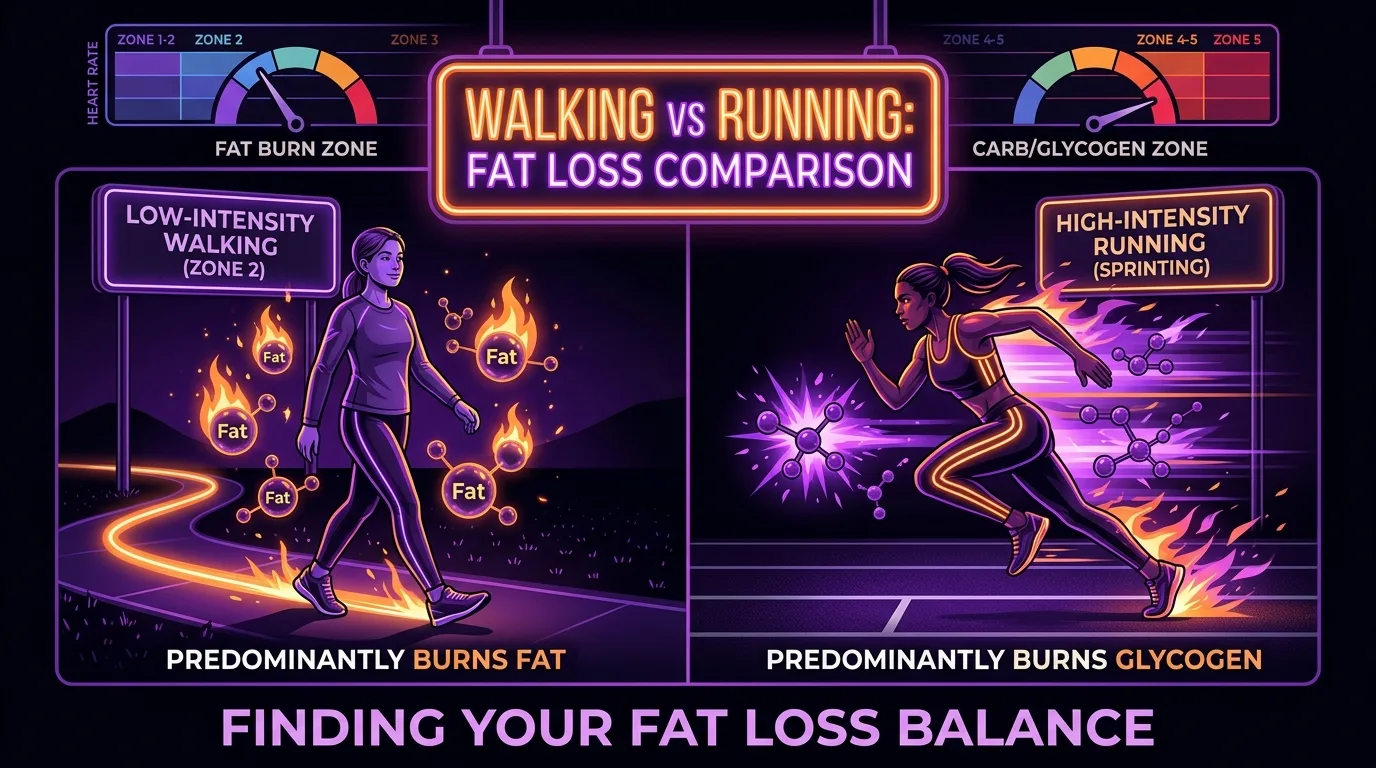
The Physiology of Substrate Utilization: Fat vs Glycogen
Your body uses different fuel sources depending on exercise intensity. During high-intensity running (Zone 4 and 5), oxygen availability drops and your muscles rely almost exclusively on rapid glycogen (carbohydrates) breakdown.
During brisk walking (Zone 2, roughly 60 to 70 percent of maximum heart rate), oxygen delivery remains abundant. Your mitochondria prioritize fatty acid beta-oxidation, drawing up to 70 percent of total energy directly from stored body fat and visceral fat stores.
Head-to-Head Comparison: Walking vs Running
| Parameter | Brisk Walking (Zone 2) | Moderate Running (Zone 4) |
|---|---|---|
| Primary Fuel Source | 60 - 70% Fat, 30 - 40% Glycogen | 20 - 30% Fat, 70 - 80% Glycogen |
| Joint Impact Load | 1.2x bodyweight per stride | 3.0x to 4.5x bodyweight per stride |
| Injury Risk Rate | Extremely Low (< 2%) | High (Up to 50% annual injury rate) |
| Post-Workout Appetite | Suppressed or neutral | Severe hunger spikes (ghrelin surge) |
| Recovery Time Required | Zero (Can perform 7 days a week) | 24 to 48 hours for joint/tendon repair |
The Appetite and Cortisol Advantage of Walking
A common trap with running is compensatory eating. Running for 30 minutes burns roughly 350 calories but depletes liver glycogen, triggering powerful ghrelin surges that cause you to overeat by 600 calories at dinner. In contrast, steady walking does not trigger acute hunger responses, making calorie deficits easy to maintain.
Daily Step Consistency Rule
Walking 10,000 steps daily expends between 400 and 500 calories without raising resting cortisol levels, creating a sustainable metabolic environment for long-term fat loss.
Turn Daily Steps into a Social Game
With StepLeague: Pedometer & Walking App, you can track daily steps, monitor calorie expenditure automatically, and compete with friends in motivating weekly league tiers.
Zone 2 & Heart Rate Zones Calculator (Karvonen & Tanaka Formula)
Calculate your clinical maximum heart rate, Heart Rate Reserve (HRR), and precise BPM ranges for maximum mitochondrial fat oxidation.
All 5 Cardiovascular Training Zones:
Steps to Calories, Distance & Fat Burn Calculator
Estimate exact energy expenditure, walking distance, and Zone 2 fat oxidation based on your steps.
Steps & Distance Needed to Burn Target Calories / Fat
Input your desired calorie deficit or target grams of pure body fat to calculate the exact steps, kilometers, and walking duration required.
Body Mass Index (BMI) & Healthy Weight Calculator
Calculate your clinical Body Mass Index and healthy weight bracket according to World Health Organization (WHO) standards.

