Over the past several years, hundreds of news reports and legal investigations have revealed illicit hidden surveillance cameras discovered inside private bedrooms, dressing rooms, and bathrooms in vacation rentals and boutique hotels worldwide. In response, major booking platforms have officially updated their terms to prohibit indoor recording devices entirely.
However, platform rules do not physically stop malicious hosts or previous occupants from leaving concealed equipment behind. According to surveillance countermeasures outlined on Wikipedia's Hidden Camera Security archive and Federal Trade Commission (FTC) Privacy Guidelines, conducting a systematic 3-minute physical inspection upon check-in gives you complete peace of mind.
The 7 Most Common Concealment Spots
Miniature spy cameras require a direct line of sight toward beds, showers, or living areas, as well as a power source or rechargeable battery:
| Common Hiding Object | Concealment Technique | Inspection Method | Risk Level |
|---|---|---|---|
| Smoke Detectors | Tiny pinhole lens facing downward over beds | Flashlight reflection / lens glitter test | High |
| Digital Alarm Clocks | Concealed behind semi-transparent front tinted acrylic | Hold flashlight against glass / magnetic sensor scan | Critical |
| USB Wall Chargers & Adapters | Micro pinhole in the faceplate near the USB port | Inspect front plastic for unusual dark circles | High |
| Bathroom Mirrors | Two-way glass with camera mounted behind silvering | Fingernail gap test (look for reflective gap) | Critical |
| Air Vents & Ceiling Grilles | Mounted inside ductwork with wide-angle lens | High-beam phone flashlight inspection | Moderate |
| TV Soundbars & Set-Top Boxes | Integrated into speaker mesh or infrared receivers | Visual inspection and magnetic field scanner | Moderate |
| Decorative Picture Frames | Pinhole in the frame border or canvas print | Check frame edges for irregular holes | Moderate |
The 3-Step Room Sweep Protocol
- Step 1: Turn Off All Lights for the Lens Reflection Test: Turn off room lights and draw curtains. Slowly shine your phone flashlight around the room at eye level. Camera lenses are made of treated glass and will reflect a distinct glint of light directly back to your eyes.
- Step 2: Scan for Infrared Night-Vision LEDs: Many spy cameras use invisible 850nm or 940nm infrared LEDs to record in total darkness. Open your smartphone camera with a specialized optical filter to spot glowing purple or white dots.
- Step 3: Perform an Electromagnetic Sensor Scan: Every electronic device emits a localized electromagnetic field. Hold your phone within 2 inches of suspicious electronics to detect hidden transformers, microphones, and transmission chips.
What to Do If You Find a Hidden Camera
Do not touch or dismantle the device. Photograph the camera in place, cover it with a towel, immediately contact local law enforcement to file an official report, and notify your booking platform for an emergency relocation.
Protect Your Personal Privacy Anywhere
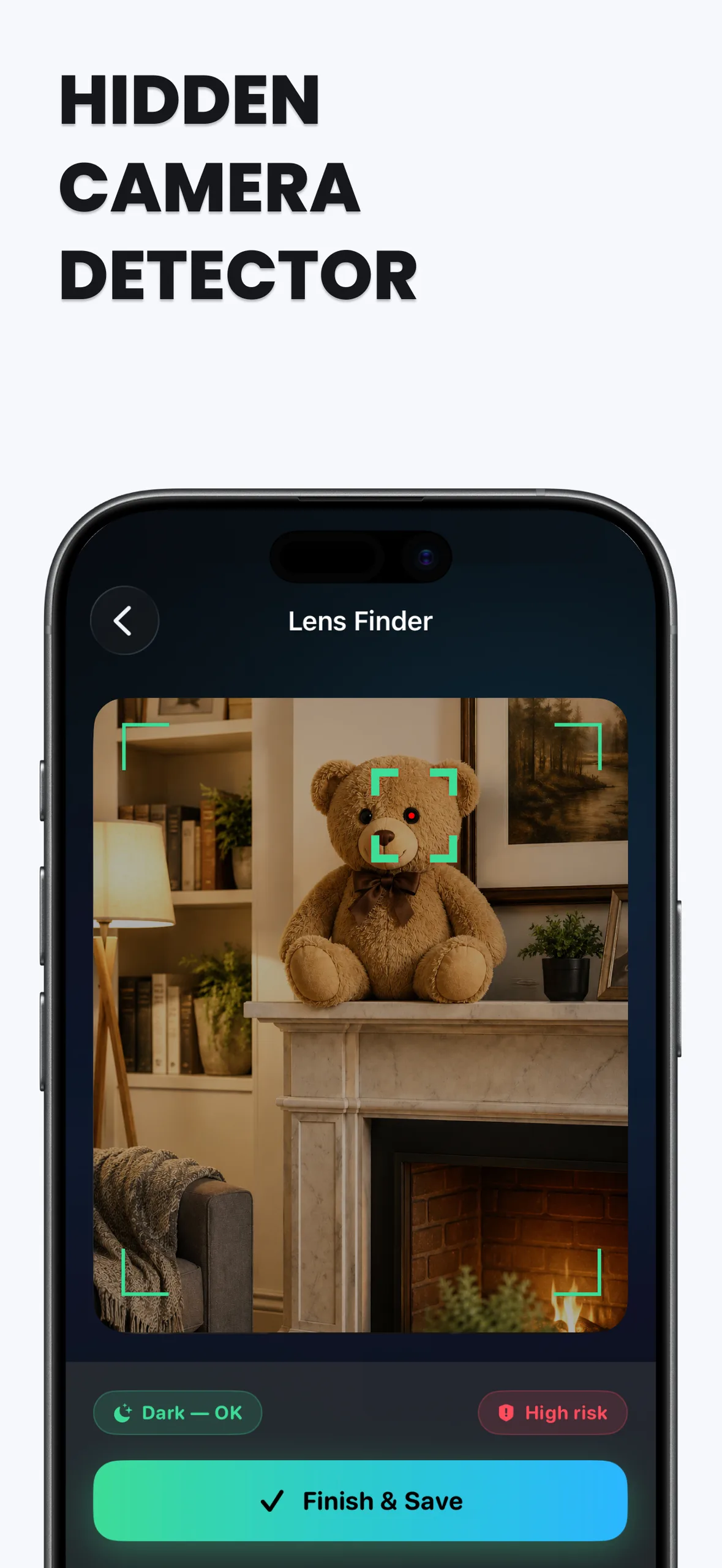
Using Hidden Camera Detector App gives you specialized tools including magnetometer frequency scanning, infrared optical filters, and local network Wi-Fi device analyzers right on your smartphone.